
An RO membrane does not fail all at once. Output slows, the water gets saltier, and the pump works harder, a little more each month. The membrane maker publishes the exact points at which you should act, and most of the time the first step is a cleaning, not a replacement. Below are the signs, how to decide between cleaning and replacing, and how to pick the right element when you do replace one.
Three signs your membrane needs attention
Dow’s FILMTEC technical manual explains that RO elements foul with mineral scale, biological matter, colloidal particles and insoluble organic material. Deposits build up until they cause a loss of normalized permeate flow, a loss of normalized salt rejection, or both. The manual says to clean the elements when one or more of these apply (Dow FILMTEC Technical Manual, section 6.3):
- The normalized permeate flow drops 10%.
- The normalized salt passage increases 5% to 10%.
- The normalized pressure drop, which is feed pressure minus concentrate pressure, increases 10% to 15%.
“Normalized” means the readings are compared with a reference while feed water composition, pressure, temperature and recovery are taken into account. The manual gives an example: a feed temperature drop of 4 degrees Celsius causes a permeate flow decrease of about 10%, which is normal and not a sign of fouling. It strongly recommends recording normalized data daily, because that allows early identification of scaling or fouling, and it says complete records are also needed for a performance warranty claim (Dow FILMTEC Technical Manual, sections 5.6 and 5.6.6). Keep a daily log of feed pressure, concentrate pressure, permeate flow, permeate TDS and temperature. Without it, you only notice the problem when the water tastes wrong.
Clean first, replace second
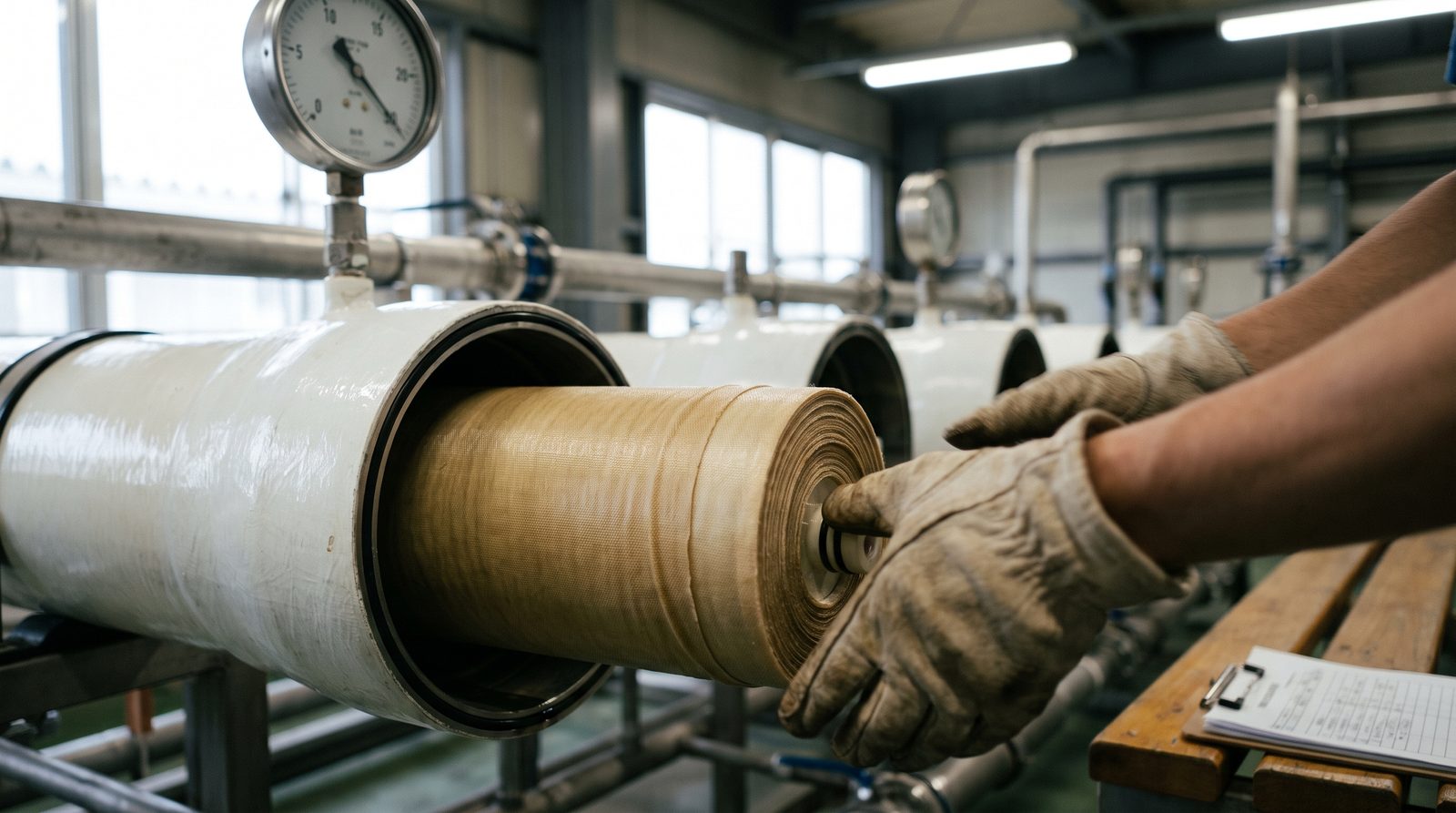
Cleaning removes the deposits that cause those three signs. The manual notes that cleaning solutions have pH limits that depend on the element type, so use the maker’s table for your element before you clean. If cleaning no longer brings performance back, or the membrane is physically damaged, replace it.
Before you buy a new element, check what damaged the old one. AMPAC’s commercial RO guidance says most premature membrane failure traces back to pretreatment that should have caught something. Hard water scales membranes, chlorine damages them and sediment fouls them. A fresh membrane behind a worn sediment cartridge or a spent carbon filter will foul again. Replace the pretreatment cartridges, such as the sediment filter S10-5, carbon block CB-10-5m or a replacement filter kit, at the same visit.
How long membranes last
Our commercial RO page plans for membrane replacement on a two to five year cycle. Your number depends on feed water, pretreatment and how well the system is maintained. On Wasatch Front feed water, which is very hard, scale control makes the biggest difference. Check our Utah water hardness by city page and use the commercial RO maintenance checklist to keep the log and the schedule.
Choose the right replacement element
Match four things: the element size, the element type (brackish or seawater), the number of elements in each vessel, and the maker’s series. The label on the old element gives you the series and size. The sizes below are listed in our catalog.
| Element | Size and type |
|---|---|
| Brackish RO membrane | 2.5 x 21 inch, brackish |
| Brackish RO membrane | 4 x 21 inch, brackish |
| Brackish RO membrane and BW30-4040 | 4 x 40 inch, brackish |
| Brackish RO membrane | 8 x 40 inch, brackish |
| BW30-365 | BW30 series, brackish |
| Seawater RO membrane | 4 x 40 inch, seawater |
| Seawater RO membrane | 8 x 40 inch, seawater |
| TW30-1812-50, TW30-1812-75 and TW30-1812-100 | TW30-1812 series |
For brackish or seawater, go by your feed water. AMPAC’s brackish range covers about 1,000 to 10,000 ppm TDS. Ocean water carries about 35,000 ppm of salt, according to the USGS (USGS, 2026), and that needs a seawater element. Browse the full range under RO membranes, membrane elements and RO parts and components.
Need the right membrane for your system?
Send the model on the old element’s label, how many elements you run and a recent permeate TDS reading. We will confirm the match and quote it within 24 hours.
What affects the price
Membrane pricing depends on the element size, brackish or seawater type, the series, how many elements you need and shipping. Send the model and we quote the exact match, so you do not pay for the wrong element. Replacing only the membranes is the cheaper job when the rest of the system is healthy. If the pressure vessels, pump or controls are worn, tell us and we will look at the whole system.
What to have ready
- The model number or series printed on the old element
- Element size and how many sit in each vessel
- Feed type (city, well, brackish or seawater) and a recent water report
- Your last permeate TDS and flow readings, plus feed and concentrate pressure
Frequently Asked Questions
How do I know it is time to replace an RO membrane?
The maker’s cleaning triggers are a 10% drop in normalized permeate flow, a 5% to 10% rise in normalized salt passage or a 10% to 15% rise in normalized pressure drop. Clean first. If a cleaning does not restore performance, replace the element.
How long does an RO membrane last?
Our commercial RO page plans for replacement on a two to five year cycle. Feed water quality, pretreatment and maintenance decide where you land in that range.
Can I use any membrane that fits my housing?
Size is not enough. You also need the right type for your feed water, brackish or seawater, and a series that suits your operating pressure. Send the label model and we will confirm the match.
Why does my new membrane foul quickly?
Usually because the pretreatment is not protecting it. Worn sediment or carbon cartridges, missing scale control on hard water, or chlorine reaching the membrane will foul or damage a new element. Fix the pretreatment when you replace the membrane.
Conclusion
Log your readings, act on the maker’s cleaning triggers, replace the pretreatment cartridges, and only then replace the membrane if cleaning has not worked. Request a quote from AMPAC Water Systems with your element label and we will match the replacement.
Sources
- Dow FILMTEC Reverse Osmosis Membranes Technical Manual, Form No. 609-00071-0416 (mirror copy)
Section 6.3, Cleaning Requirements: the foulant types and the three cleaning triggers (10% permeate flow drop, 5% to 10% salt passage rise, 10% to 15% pressure drop rise). Section 5.6.6: normalization, and the 4 degrees Celsius temperature example. A 2016 manual, so check the maker’s current edition for your element. - USGS Water Science School: Saline water and salinity
The figure of about 35,000 ppm of salt in ocean water.
AMPAC Water Systems designs and manufactures advanced water treatment solutions for commercial, industrial, and municipal applications. From RO systems and PFAS removal to zero liquid discharge and smart water technology — engineered for your needs.