
If you’re searching for an 8,000 GPD commercial RO system, you already have a water demand number in hand and you need to know what fits it. That’s a narrower question than most buyer’s guides answer. This post skips the generic sizing tutorial and goes straight to which facilities actually need this capacity, what the market charges for it, and what to check before you commit a purchase order.
AMPAC Water Systems designs and manufactures commercial reverse osmosis systems in Woods Cross, Utah, and builds RO trains across this exact capacity range for hospitality, car wash, and light industrial customers. The specs and guidance below reflect what our engineering team fields in quote conversations every week.
TL;DR: An 8,000 GPD commercial RO system typically fits mid-size hotels (roughly 150-250 rooms), tunnel car washes, breweries, and light manufacturing sites with moderate process water needs. Third-party market pricing for off-the-shelf 8,000 GPD units ranges from $8,858 to $16,853 depending on configuration (AXEON Water Technologies product listing, 2026). AMPAC does not publish fixed pricing for custom-engineered systems, so request a quote for an exact number.
What Size Facility Actually Needs an 8,000 GPD System?
An 8,000 GPD system fits facilities with moderate, steady water demand - think mid-size hotels, tunnel car washes, breweries, and light industrial plants running one or two shifts. It sits above small point-of-use RO units and below the multi-train industrial systems built for large manufacturing campuses. If your facility runs continuous production or serves 300+ hotel rooms, you’re likely looking at a larger custom array instead.
In our quoting conversations, the 8,000 GPD tier is less about a single occupancy formula and more about matching peak-hour draw. A hotel with heavy laundry and cooling tower use can need this capacity at 150 rooms, while a lower-intensity property might not need it until well past 250. Car washes and breweries follow their own logic entirely - tunnel length and rinse-cycle count matter more than square footage.
Why This Range Sits Between Point-of-Use and Industrial Trains
Smaller commercial systems typically serve single-building use like restaurants or small offices, where demand is lighter and more predictable. Once facilities need meaningfully higher output than 8,000 GPD, most move toward multi-train industrial configurations built for redundancy. The 8,000 GPD band sits near the practical ceiling for a single-skid commercial system before redundancy planning becomes a real design conversation.
How Much Does an 8,000 GPD Commercial RO System Cost?
Published market pricing for 8,000 GPD systems spans roughly $8,858 to $16,853 across major manufacturers, with the spread driven by pretreatment, controls, and membrane configuration rather than raw capacity alone. It’s a wide range for the same rated output, telling you the skid itself is only part of the price.
Three publicly listed reference points illustrate the spread. The AXEON N-8000 lists between $8,858 and $16,853 depending on options (AXEON Water Technologies, 2026). The Nelsen NRO-F-5440F-8000 is listed at $10,766 (Nelsen Corporation, 2026). RainDance’s 8000GPD unit lists at $13,898 (RainDance Water Systems, 2026). Treat these as market anchors, not a quote, since none of them are AMPAC’s own pricing.
What About AMPAC’s Pricing?
AMPAC does not publish flat pricing for 8,000 GPD systems on its website, because most units in this range are configured to a specific water source, feed water quality, and facility layout. A hotel pulling from municipal supply and a car wash recycling its own rinse water need different pretreatment stages even at identical GPD ratings, which is why we quote each project individually rather than posting a single price tag.
If you need a number to budget against, the fastest path is a request for quote with your feed water source, target output, and available install space. Most quotes come back within a few business days once feed water data is in hand.
Where Do 8,000 GPD Systems Fit - Hospitality, Car Wash, and Light Industrial?
Hospitality, car wash, and light industrial operations pull water for very different reasons, but they land in the same 8,000 GPD tier because their peak demand periods are similarly moderate and predictable. Matching the system to the actual use case, not just the number, is what determines whether it performs well long term.
Mid-size hotels. Laundry operations, kitchen equipment, cooling towers, and guest room fixtures combine to push water demand into this range for many 150-250 room properties. Laundry and cooling tower makeup water tend to be the two biggest swing factors, since both run on their own schedules independent of occupancy.
Car washes. Tunnel washes recycling rinse water or producing spot-free final rinse commonly land here, especially operations running multiple bays or high daily car counts. Recovery rate matters more for car washes than almost any other vertical, since reclaim water quality affects the finish customers actually see.
Breweries. Process water, clean-in-place (CIP) cycles, and product water for smaller-batch breweries often fall into the 8,000 GPD band before a facility scales into industrial-size production. Consistent feed water chemistry matters here because RO permeate quality directly affects product taste and shelf stability - see AMPAC’s water treatment guide for craft breweries for how water chemistry shapes beer quality.
Light industrial. Boiler feed water, wash-down operations, and general process water for single-shift manufacturing plants frequently sit in this range too. These sites tend to have the most flexible pretreatment needs, since feed water can range from municipal to well to partially reclaimed process water.
Each of these applications needs different pretreatment ahead of the RO membranes - a car wash reclaiming its own water needs more aggressive filtration than a hotel on clean municipal supply. Our commercial reverse osmosis systems page covers the pretreatment options available across this capacity range.
How Does an 8,000 GPD System Compare on Capacity, Footprint, and Power?
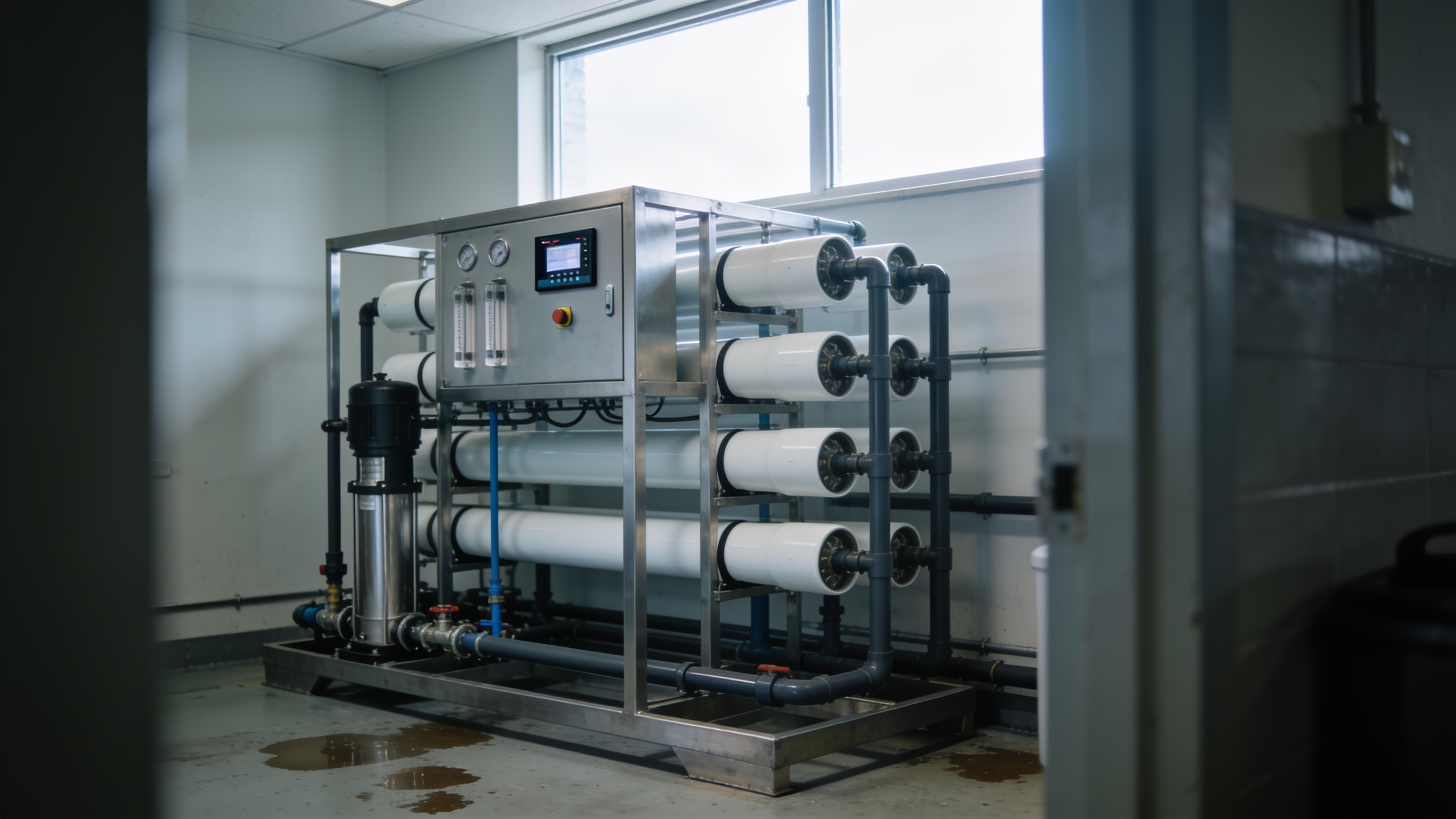
Rated capacity alone doesn’t tell you whether a system fits your mechanical room or your electrical service. Footprint and power draw vary by pretreatment stage count and pump configuration, even among systems rated at the same 8,000 GPD output.
| System | Rated Capacity | Typical Footprint | Typical Power | Market Price |
|---|---|---|---|---|
| AMPAC 8,000 GPD Commercial RO | 8,000 GPD | Custom-sized to install space | 208-230V or 460V, 3-phase (per config) | Quote required |
| AXEON N-8000 | 8,000 GPD | Standard commercial skid | 3-phase, per manufacturer spec | $8,858-$16,853 |
| Nelsen NRO-F-5440F-8000 | 8,000 GPD | Standard commercial skid | 3-phase, per manufacturer spec | $10,766 |
| RainDance 8000GPD | 8,000 GPD | Standard commercial skid | 3-phase, per manufacturer spec | $13,898 |
Footprint and power figures for the AXEON, Nelsen, and RainDance units reflect typical specifications for systems in this capacity class; confirm exact dimensions and voltage requirements directly with each manufacturer before ordering. The line item that catches most facility managers off guard isn’t the skid price - it’s whether their existing electrical service can support a three-phase RO pump package without a panel upgrade. Check your service capacity before you finalize a system, not after.
8,000 GPD on Utah water: what goes in and what goes down the drain
AMPAC’s commercial RO page lists systems from 100 to 8,000 GPD, and its industrial line starts at 6,000 GPD. The AP6000-LX page says AMPAC builds that model in capacities from 1,500 to 8,000 GPD, and the AP10K-LX sits just above at 10,000 GPD. Those two pages hold the closest published specs to an 8,000 GPD build.
| Spec | AP6000-LX | AP10K-LX |
|---|---|---|
| Rated output | 6,000 GPD (4.17 GPM) | 10,000 GPD (7.0 GPM) |
| Membranes | 3 x 4-inch by 40-inch TFC | 1 x 8-inch by 40-inch TFC |
| Motor | 2 hp | 3 hp |
| Typical recovery | 33% to 50% | 33% to 70% |
| Power | 110 or 220 V, single or three phase | 208-230, 380 or 440 V, single or three phase |
| Footprint and weight | 52 x 30 x 62 in, 240 lb | 84 x 44 x 72 in, 650 lb |
Recovery decides how much water an 8,000 GPD skid pulls in. Divide the 8,000 gallons of permeate by the recovery rate to get feed, and everything else goes to drain. The recovery figures come from the two AMPAC pages; the arithmetic is ours.
- 33% recovery: about 24,200 GPD in, about 16,200 GPD to drain
- 50% recovery: 16,000 GPD in, 8,000 GPD to drain
- 70% recovery: about 11,400 GPD in, about 3,400 GPD to drain
For local scale, take Woods Cross City’s 2025 water quality report. It lists 350,822,000 gallons used, about 960,000 gallons a day, from three deep wells and one Weber Basin connection. A skid running at 33% recovery would draw about 2.5 percent of that average day. The same report puts average hardness at 23 grains per gallon. AMPAC ties the AP10K-LX recovery range to feed salinity and hardness, so on water this hard, plan the reject line around the low end until you have a quote built on your own water analysis.
Sources: Woods Cross City, 2025 Annual Drinking Water Quality Report.
Frequently Asked Questions
How long does installation of an 8,000 GPD system take?
Installation timelines vary by pretreatment complexity and site readiness, but commercial RO systems in this capacity range typically take one to two weeks to install once the skid arrives on site. Feed water piping and electrical hookup usually drive the schedule more than the RO unit itself.
Can an 8,000 GPD system run on well water instead of municipal supply?
Yes, but well water generally requires more pretreatment, such as sediment filtration, iron removal, or softening, before it reaches the RO membranes. Feed water testing before purchase determines exactly which pretreatment stages a well-fed system needs.
What maintenance does an 8,000 GPD RO system need?
Routine maintenance includes periodic membrane cleaning, pre-filter replacement, and monitoring of permeate quality and recovery rate. Maintenance frequency depends heavily on feed water quality and daily run hours, so hotels and car washes often follow different service schedules.
Do I need pretreatment for a system this size?
Almost always. Membrane life at 8,000 GPD output depends heavily on removing chlorine, sediment, and scale-forming minerals before water reaches the RO stage. Skipping pretreatment is the single most common reason commercial systems underperform their rated capacity.
Getting the Right System for Your Facility
An 8,000 GPD commercial RO system works well for mid-size hotels, car washes, breweries, and light industrial facilities with moderate, steady water demand. Market pricing for off-the-shelf units runs roughly $8,858 to $16,853 (AXEON Water Technologies, 2026), but the right system for your facility depends on feed water quality, pretreatment needs, and available install space just as much as the GPD number on the spec sheet.
Rather than guessing at a system that’s rated correctly on paper but mismatched to your actual water source, AMPAC engineers each commercial RO system around your feed water and facility layout. Request a quote with your target output and water source, and our team will size a system built for your specific application.