
Most zero liquid discharge content online is written for power-plant scale operators with eight-figure budgets. That leaves mid-size commercial and industrial facilities, plants discharging somewhere between a few thousand and a few hundred thousand gallons a day, without a clear equipment roadmap. This post fills that gap. If you’re still asking what ZLD is and why regulators are pushing toward it, start with Zero Liquid Discharge (ZLD) Systems: Is It Right for Your Industrial Facility? first. Here, we build the train stage by stage.
TL;DR: A mid-size ZLD system is built in three stages: RO pre-concentration, brine concentration, and evaporation/crystallization. Combined membrane-plus-thermal designs typically reach 95-99% water recovery (WCPonline, 2024), and RO pre-concentration does the bulk of that volume reduction before the more expensive thermal stages engage.
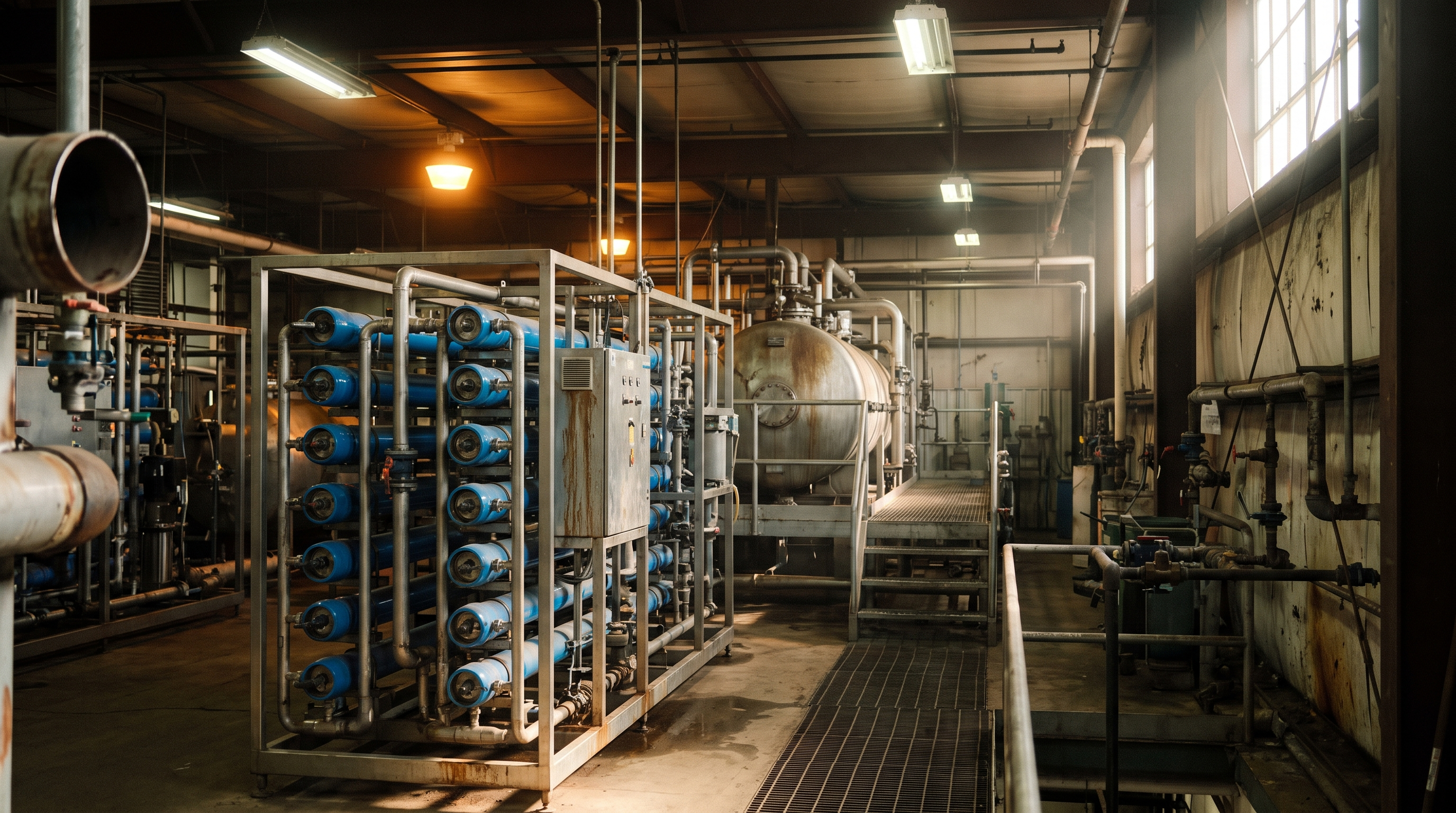
What Equipment Makes Up a Mid-Size Zero Liquid Discharge System?
A mid-size ZLD system is built from three sequential stages, not one machine. Each stage exists to shrink wastewater volume further before it reaches the next, more expensive step. The global ZLD market is valued between $9.15 billion in 2026 and a projected $13.65 billion by 2031, growing at roughly 8.3% CAGR (Fairfield Market Research, 2026).
Why build it in stages instead of running everything through one evaporator? Cost. Thermal evaporation runs several times more expensive per gallon than membrane filtration, so the design goal is simple: push RO to do as much volume reduction as the feed water chemistry allows, and only send the leftover concentrate to thermal treatment.
| Stage | Primary Function | Typical Equipment | Role in Volume Reduction |
|---|---|---|---|
| 1. RO Pre-Concentration | Bulk volume reduction | Multi-stage RO skid, cartridge/media pretreatment, antiscalant dosing | Largest single-stage reduction, lowest cost per gallon |
| 2. Brine Concentrator | Secondary concentration | Vibratory or falling-film brine concentrator, often paired with a second RO pass | Shrinks RO reject further before thermal |
| 3. Evaporator/Crystallizer | Final solids removal | Forced-circulation crystallizer, dryer, or evaporation pond (climate-dependent) | Produces dry solids or near-zero discharge |
Chemicals, textiles, pharmaceuticals, and pulp/paper are the industries adopting ZLD fastest right now, largely driven by tightening discharge permits (Fairfield Market Research, 2026). If your facility sits in one of those sectors, the equipment list above is your starting point, not your finish line - feed water chemistry changes which components you actually need.
How Does RO Pre-Concentration Cut Wastewater Volume Before Thermal Treatment?
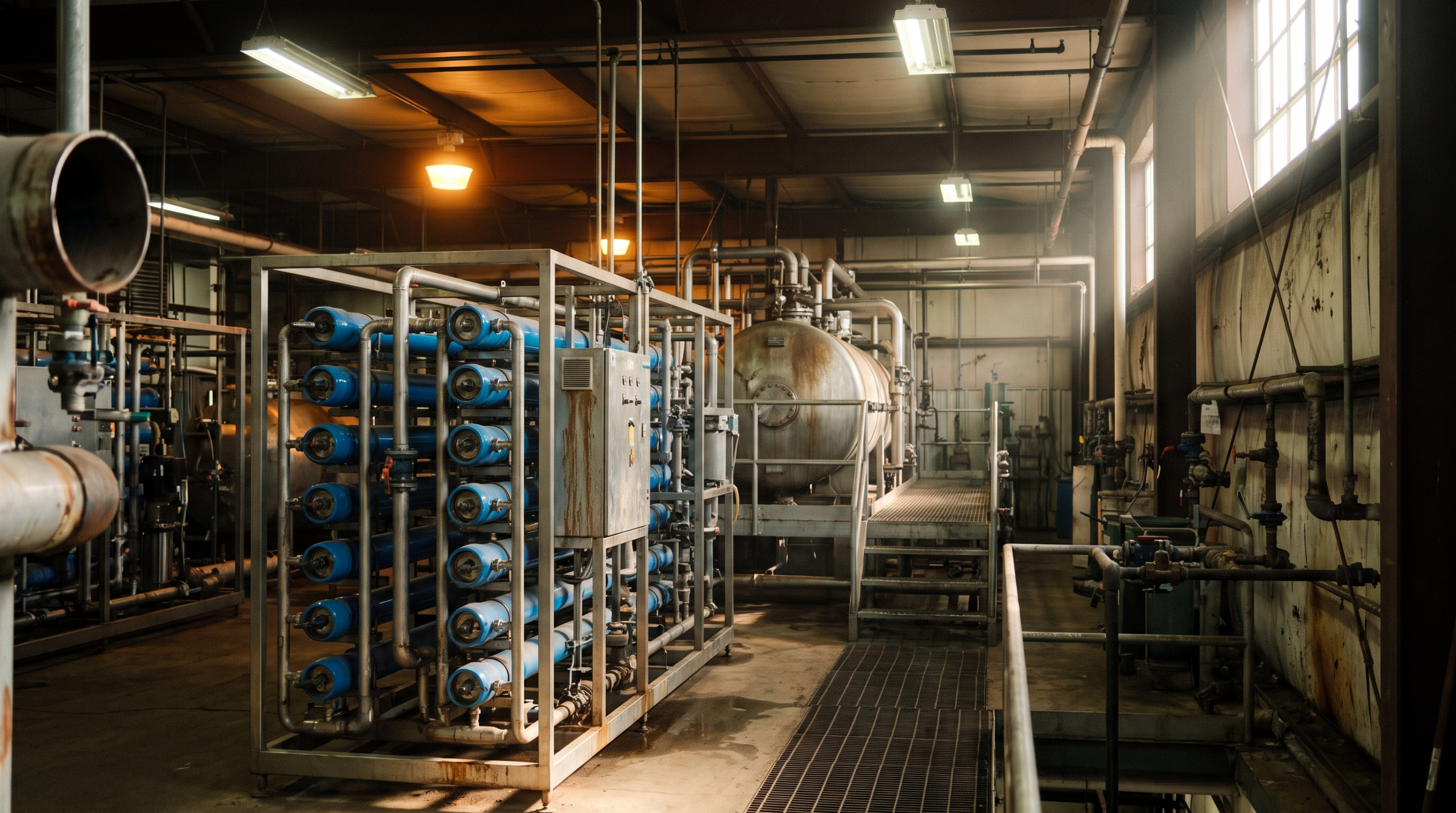
RO pre-concentration is the first and highest-leverage stage in a mid-size ZLD train, and it’s where most of the cost savings live. By pushing wastewater through semi-permeable membranes before any thermal step, a well-designed RO system removes the majority of water volume at a fraction of the energy cost of evaporation. Combined membrane-plus-thermal ZLD trains reach 95-99% overall water recovery (WCPonline, 2024), and RO does the heavy lifting to get there.
Most ZLD content written for the enterprise/power-plant tier leads with the evaporator, treating RO as an afterthought. For a mid-size facility, that ordering is backwards: sizing the RO stage correctly is what determines whether the downstream thermal equipment needs to be a small unit or a large, expensive one. Get pre-concentration right and everything after it shrinks.
Where AMPAC’s Industrial RO Line Fits This Stage
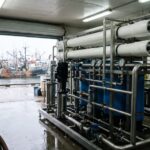
AMPAC Water Systems builds industrial RO systems in capacities from 6,000 GPD up to 25,000 GPD, skid-mounted for straightforward installation on a mid-size plant floor. Larger jobs can move to containerized or modular builds with SCADA-ready remote monitoring, the same footprint flexibility that separates mid-size design from a power-plant-scale build.
In practice, facilities that undersize pretreatment ahead of the RO stage, skipping proper antiscalant dosing or media filtration, end up scaling membranes faster and losing recovery within the first year. Pretreatment sizing is not optional; it’s the difference between a system that hits its recovery target and one that needs early membrane replacement.
Citation capsule: Combined membrane pre-concentration and thermal crystallization in a zero liquid discharge system typically achieve 95-99% total water recovery, with RO handling the majority of volume reduction before the more costly thermal stages engage (WCPonline, “Zero Liquid Discharge and High Recovery Reverse Osmosis,” 2024).
What Does a Brine Concentrator Do After RO Pre-Concentration?
A brine concentrator takes the reject stream RO couldn’t process further and shrinks it again before it reaches thermal crystallization. This second-stage concentration step matters because it directly reduces the size, and therefore the cost, of the evaporator or crystallizer downstream. Skipping it means oversizing the most expensive piece of equipment in the entire train.
Brine concentrators typically use vibratory or falling-film evaporation technology, sometimes paired with a second RO pass if the concentrate chemistry still allows membrane treatment. For a mid-size facility, this stage is often the one engineers try to shrink or skip to save capital cost, usually a mistake: a brine concentrator sized correctly can cut the crystallizer’s required capacity substantially, which lowers both upfront equipment cost and ongoing energy draw.
Does every mid-size facility need a standalone brine concentrator? Not always. Facilities with lower TDS feed water and generous RO recovery may be able to route concentrate directly to a smaller crystallizer. It comes down to feed water chemistry and discharge volume, which is exactly the kind of sizing question worth running past an engineer before committing to equipment.
How Does the Evaporator/Crystallizer Stage Achieve Zero Discharge?
The evaporator/crystallizer is the final stage, and it’s what actually gets a facility to zero liquid discharge by driving the remaining concentrate down to dry solids. Enterprise-scale HPD evaporator and crystallizer systems, the kind Veolia builds for large industrial and power-plant clients, recover more than 95% of the wastewater that reaches them (Veolia Water Technologies, 2024).
For a mid-size facility, the crystallizer doesn’t need to match that enterprise footprint. Because RO and the brine concentrator have already stripped out most of the volume, the crystallizer only has to process what’s left, often a small fraction of the original wastewater stream. Getting the earlier stages right pays off here: a smaller thermal footprint, lower energy cost, and a shorter path to a permit-compliant, near-zero discharge outcome.
How Is a Mid-Size Zero Liquid Discharge System Different From Enterprise Power-Plant Systems?
Mid-size ZLD design differs from enterprise power-plant systems mainly in footprint, modularity, and cost tier, not in the underlying three-stage sequence. Industry analysts note a clear 2026 shift toward modular, scalable ZLD designs built specifically for small- and mid-size industrial plants rather than the massive centralized systems power utilities use (Fairfield Market Research, 2026). If your facility is asking whether it needs ZLD at all before diving into equipment sizing, Zero Liquid Discharge: The Future of Industrial Wastewater Management covers the regulatory and cost drivers pushing more mid-size plants toward ZLD in the first place.
A power-plant-scale ZLD train might process millions of gallons a day across acres of equipment. A mid-size facility, by contrast, typically needs a system that fits inside an existing plant footprint or a single containerized unit outside it. That means skid-mounted RO instead of custom-built membrane halls, smaller brine concentrators, and crystallizers sized in the hundreds-of-gallons-per-day range rather than thousands.
Cost follows the same pattern. Enterprise ZLD projects run into eight figures; mid-size systems, because they lean harder on RO pre-concentration to shrink the load reaching thermal equipment, come in at a fraction of that. The design principle worth remembering: the more work RO does upfront, the less every downstream stage has to cost.
Zero Liquid Discharge in Utah: The Colorado River Basin’s No-Salt-Return Policy
Utah plants in the Colorado River Basin face a salt rule that Wasatch Front plants, where AMPAC is based, do not. The Salinity Control Forum’s NPDES policy applies an objective of “a no-salt return policy whenever practicable” to new and reissued industrial permits, and Utah’s Division of Water Quality writes its basin permits to that policy. The Utah side of the basin covers the Green, Duchesne, White, Price, San Rafael, lower San Juan and Virgin river drainages, among others.
A permit can still issue when preventing all salt discharge is not practicable, when the load stays under one ton per day (366 tons a year), or when the effluent counts as fresh water, defined as 500 mg/L TDS or less above Lees Ferry. Other applicants must show their reuse options and the cost per ton of salt removed, and explain how removed salt stays out of surface water and groundwater. As of December 31, 2022, the Forum’s review lists 71 Utah discharge permits in the basin, 39 of them industrial (7 since terminated). Several Utah coal-mine permits carry salinity offsets for load above the one-ton line.
For scale, this is how much water carries one ton of salt per day (our arithmetic, in U.S. tons):
| Concentrate or blowdown TDS | Flow carrying one ton of salt per day |
|---|---|
| 2,000 mg/L | about 120,000 gal/day |
| 5,000 mg/L | about 48,000 gal/day |
| 10,000 mg/L | about 24,000 gal/day |
In the Uinta Basin, oil and gas producers dispose of salty produced water three main ways: about 60% goes down injection wells, 18% to waterfloods and 11% to lined evaporation ponds. Most of it exceeds 10,000 mg/L TDS. The Utah Geological Survey calls injection the preferred method over ponds (2016 data, published May 2018).
That 10,000 mg/L mark matches the rating on AMPAC’s standard skids. The AP12K-LX lists a maximum feed salinity of 10,000 ppm, and the AP25K-LX rates its output on a 10,000 ppm NaCl feed. Saltier streams fall outside those ratings and call for a custom design; the industrial RO line covers 6,000 to 25,000 GPD as standard. RO shrinks the volume but leaves the salt in the concentrate, which then carries about the same salt load as the feed.
Sources: Colorado River Basin Salinity Control Forum, 2023 Review (October 2023); Utah Geological Survey, Survey Notes v. 50 no. 2 (May 2018).
Frequently Asked Questions
What recovery rate can a mid-size ZLD system realistically achieve?
Combined RO pre-concentration and thermal crystallization systems typically reach 95-99% water recovery (WCPonline, 2024). Actual recovery at a specific mid-size facility depends on feed water chemistry, TDS levels, and how well the RO stage is sized and maintained.
Does RO pre-concentration replace the need for thermal evaporation?
No. RO reduces the bulk of the volume, but it can’t reject 100% of dissolved solids on its own. The remaining concentrate still needs a brine concentrator and evaporator/crystallizer stage to reach true zero liquid discharge.
How much does a mid-size ZLD system cost compared to enterprise-scale systems?
Enterprise ZLD builds for power plants and large industrial sites run into eight figures. Mid-size systems cost a fraction of that because heavier reliance on RO pre-concentration shrinks the size, and cost, of the downstream thermal equipment.
Which industries need zero liquid discharge at mid-size scale?
Chemicals, textiles, pharmaceuticals, and pulp/paper manufacturers are adopting ZLD fastest, largely due to tightening wastewater discharge permits (Fairfield Market Research, 2026). Mid-size plants in these sectors are the primary audience for modular ZLD designs.
Getting Your ZLD Train Sized Right
Building a zero liquid discharge system for a mid-size facility comes down to one principle: let RO pre-concentration carry as much of the load as your feed water chemistry allows, then size the brine concentrator and crystallizer to handle only what’s left. Get that sequencing right and the whole system costs less to build and less to run.
Every facility’s feed water is different, so the right stage-by-stage design depends on your specific TDS, flow rate, and discharge requirements. Request a quote to talk through sizing for your facility with AMPAC’s engineering team.