
Your plant runs on water. Whether you’re producing beverages, washing semiconductor wafers, running a boiler, or processing food, the moment your reverse osmosis system goes down you’re not just losing purified water — you’re losing production. One day offline at a mid-size food and beverage plant can cost $50,000 to $200,000 in lost throughput, expedited ingredient sourcing, and overtime. That number makes the price difference between vendors look small fast.
The problem is that most industrial water treatment buyers evaluate RO systems on upfront cost, flow rate, and rejection percentage. Those specs matter. But they don’t tell you what happens at 2 a.m. on a Saturday when your high-pressure pump fails three weeks before a production audit. That’s when vendor selection really shows its hand.
This guide covers the questions that actually separate industrial reverse osmosis manufacturers from resellers — and from each other.
Key Takeaways
- True manufacturers build and test systems at their own facility; resellers assemble from third-party skids with no factory QC.
- Factory pressure testing and FAT (Factory Acceptance Testing) documentation are non-negotiable for systems above 10,000 GPD.
- Domestic spare-parts inventory — membranes, high-pressure pumps, controls — cuts emergency repair time from weeks to days.
- Ask for a written emergency response SLA (service-level agreement) before signing. “We’ll get back to you” is not an SLA.
- US-manufactured skids carry UL-listed electrical panels and NSF-certified components by default; imported skids often require re-certification.
- Commissioning and operator training directly from the manufacturer reduces first-year failure rates significantly.

Manufacturers vs. Resellers: Why the Distinction Matters
The industrial RO manufacturer market has a reseller problem. Plenty of companies list “custom industrial reverse osmosis systems” on their websites. What they’re actually doing is purchasing stock skids from overseas factories, slapping on a logo, and selling them with a thin support wrapper. For a 500 GPD office unit, fine. For a 50,000 GPD system running a pharmaceutical fill line, that’s a different situation entirely.
Here’s a simple table to help you sort the two categories during initial vendor screening:
| Factor | True Manufacturer | Reseller |
|---|---|---|
| System design | In-house engineers size the system to your feedwater chemistry | Selects from stock configurations |
| Factory testing | Full-pressure FAT at their facility before shipment | None, or testing done overseas by the original builder |
| Spare parts | Warehouse stocked with brand-specific components | Orders from the same distributor you could call yourself |
| Emergency support | Engineers who designed the system take your call | Dispatches a third-party service tech |
| Warranty accountability | One party owns the system design and the fix | Warranty disputes can involve three companies |
| Customization | Can modify skid dimensions, control logic, materials | Limited to what the upstream factory offers |
| Lead time flexibility | Can prioritize emergency builds | Bound by overseas factory schedules |
Ask every vendor two direct questions: “Where is the system physically built?” and “Can I visit your manufacturing facility before ordering?” Resellers either deflect or offer a warehouse tour, not a factory floor.
Factory Testing: What to Look for Before Shipment
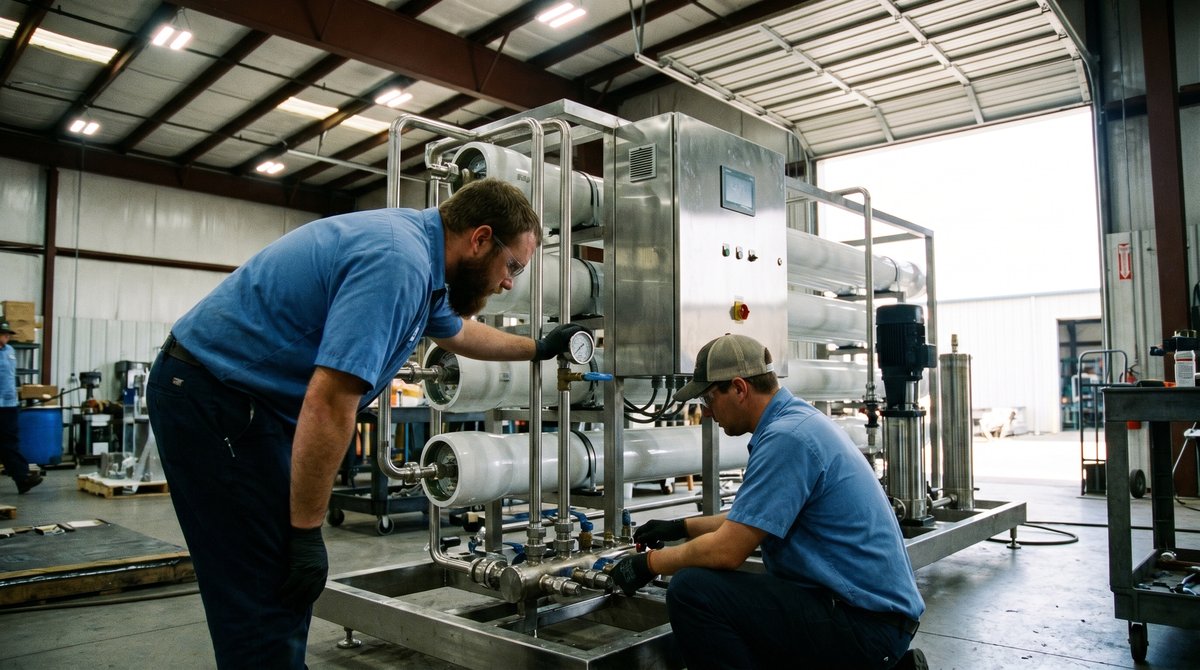
A commercial or industrial RO system is a pressurized, electromechanical system with dozens of failure points — fittings, O-rings, valve seats, sensor wiring, pressure relief settings. Factory testing isn’t a formality. It’s your last chance to catch problems before they become your problem on-site.
Any manufacturer worth the name runs Factory Acceptance Testing (FAT) on systems above a certain flow threshold. FAT should include:
- Hydrostatic pressure testing of all vessels and piping at 1.5× operating pressure
- Wet run at design flow rate using municipal water, confirming actual permeate flow and rejection match the spec sheet
- Electrical panel verification: UL listing check, breaker sizing, alarm trigger confirmation
- Controls and HMI walkthrough covering automated flush cycles, fault logging, and remote monitoring handoff
- Documentation package: P&ID drawings, as-built wiring diagrams, pump curve data, membrane lot numbers
Ask for the FAT report. If the vendor can’t produce one — or hands you a one-page checklist with no measured data — that tells you everything you need to know. Legitimate manufacturers issue multi-page FAT reports with actual flow readings, pressure readings, and rejection percentages taken at their facility. Not projections.
AMPAC systems at 10,000 GPD and above go through this process at the Utah factory before a single component ships. The customer gets the report before the truck leaves.
Membrane and Spare-Parts Availability: The Hidden Uptime Factor
Membranes foul. High-pressure pumps wear. Control boards fail after five years. This is not a design flaw — it’s physics. The real question is how quickly you can get back online when it happens.
For membrane elements, the critical question is whether your manufacturer stocks the exact elements your system uses domestically. Many imported systems use membranes sized to non-standard OD specs or proprietary end-caps that require overseas sourcing. Lead time: 6 to 12 weeks. If you’re running a municipal water district or a food-grade production line, that’s not acceptable.
Questions to ask about spare-parts programs:
- Do you stock replacement membranes for my specific system domestically? Get a yes or no, then ask for the distributor’s US warehouse location.
- What’s your average lead time on a high-pressure pump replacement? Under 5 business days is reasonable. “We’ll check with our supplier” is a red flag.
- Do you offer a recommended spare-parts kit at commissioning? Any manufacturer with real service experience will have a list ready: a set of membranes, a pump seal kit, pressure gauges, key instrumentation.
- Are your control components off-the-shelf domestic brands? Siemens PLCs, AutomationDirect sensors, and Grundfos/Goulds pumps can be serviced anywhere in the US. Proprietary imported controls cannot.
Browse our RO parts and components catalog for what’s stocked domestically for AMPAC systems.
The math on carrying a spare-parts kit is simple: a $3,000 kit sitting on a shelf is cheap insurance against a $50,000 downtime event.

Emergency Support and Downtime Cost Math
This is the question most buyers forget to ask until they’re already in a crisis. “What happens when something breaks at 2 a.m. on a Sunday?”
24/7 emergency support for reverse osmosis systems means different things from different vendors. Here’s what it should mean:
- A phone number that connects to a live engineer (or an on-call engineer who calls back within 30 minutes), not a helpdesk ticket system
- Remote access capability — most modern RO systems with network-connected PLCs allow manufacturer engineers to log in, pull alarm history, and diagnose faults without a site visit
- A defined escalation path: remote diagnosis, then local tech dispatch, then factory engineer on-site, with time targets at each step
The downtime cost varies by industry. A few realistic numbers:
- Food and beverage bottling plant, 20,000 GPD system: Production halt costs roughly $8,000 to $15,000 per hour in lost throughput plus overtime. One unplanned 8-hour outage: $60,000 to $120,000.
- Commercial laundry facility using softened RO water: Switching to city water risks equipment scale damage and rejected commercial accounts. A 48-hour outage can mean $20,000 in lost contracts plus descaling cost.
- Semiconductor fab pre-rinse circuit: Even a 2-hour interruption can require scrapping a full wafer batch. Cost: $100,000 or more.
Against those numbers, a service contract running $8,000 to $15,000 per year — with guaranteed 4-hour remote response and 24-hour on-site response — is not expensive. It’s risk management.
Ask every vendor for their written SLA before you sign a purchase order. If they don’t have one in writing, they don’t have one.
US-Made vs. Imported Skids: What the Spec Sheet Won’t Tell You
The industries AMPAC serves — food and beverage, pharmaceutical, municipal, marine — almost all operate under regulatory frameworks that care about component certification. UL-listed electrical panels. NSF/ANSI 61 certified materials in potable water contact. Pressure vessel ASME certification where applicable.
US-manufactured skids carry these certifications as a baseline because domestic code requires them. Imported skids often don’t, and buyers typically find out when a state inspector or food-safety auditor asks for documentation.
Other practical differences worth pricing in:
- Lead times. A US manufacturer can often expedite an emergency build in 4 to 8 weeks. An overseas factory order is 16 to 24 weeks minimum, plus shipping.
- Customization. US shops can modify a skid to fit a mechanical room that’s 18 inches narrower than standard. Overseas factories work from fixed molds and frame sizes.
- Warranty disputes. When a US-built system has a problem, you call one company. When an imported system fails, the warranty chain can involve the US reseller, the overseas factory, and a freight damage claim.
- Support infrastructure. A manufacturer with a US facility has engineers who can be on a plane to your site. Many importers do not.
None of this means every imported system is bad. But the certification gaps and service gaps are real, and they’re worth factoring into total cost of ownership before you sign.
Commissioning, Operator Training, and the First Year
The system arrives. It gets installed. Then what?
Commissioning by the manufacturer — not a local plumber, not an in-house maintenance tech, but the people who designed and built the system — is what separates a smooth startup from a year of “why is my rejection rate 3% low and no one can tell me why.”
Good manufacturer commissioning covers:
- Initial feedwater quality verification against the design spec — including confirming that upstream sediment pre-filtration is correctly sized for your source water. If your actual TDS is higher than the design TDS, you need to know before startup, not after.
- Full system startup with a factory engineer present
- Operator training: startup/shutdown procedures, cleaning-in-place (CIP) protocols, membrane replacement procedure, alarm interpretation
- Baseline performance documentation — permeate flow, TDS, pressure differential across membranes — so you have a reference point for future troubleshooting
The first year of operation is when most problems surface. Fouling patterns establish themselves. Control quirks show up. Operators make mistakes. A manufacturer with a serious commissioning program stays involved through that period.
Ask: “What does your commissioning package include, and is it in the price or billed separately?” Then ask: “What ongoing technical support is available in year one?”
Frequently Asked Questions
What’s the difference between an industrial RO manufacturer and a distributor?
A manufacturer designs, builds, and tests systems at its own facility. A distributor purchases pre-built systems from a factory — often overseas — and resells them, sometimes with minor modifications. The practical difference shows up in custom engineering capability, factory testing documentation, and post-sale support depth. When something breaks on a manufacturer-built system, you call the people who built it.
How much does downtime actually cost for an industrial RO system?
It depends on what the water feeds. In food and beverage, a single unplanned day offline can cost $50,000 to $200,000 in lost production. In pharmaceutical manufacturing, it can invalidate a batch run worth multiples of that. The point isn’t a single number — it’s that the cost of emergency support contracts and spare-parts kits is almost always a fraction of one downtime event.
What certifications should a US-manufactured industrial RO system carry?
At minimum: UL-listed electrical panels, NSF/ANSI 61 for any potable water contact materials, and pressure vessel construction per ASME standards where code requires it. For pharmaceutical applications, look for cGMP-compatible wetted materials and documentation supporting 21 CFR Part 11 compliance where needed. Ask for the actual certificates, not a checkbox on a spec sheet.
What questions should I ask about emergency support before I buy?
Four questions worth asking every vendor: Is there a 24/7 phone number that reaches a live engineer, and what’s the callback SLA? Does the system support remote monitoring and remote access for diagnosis? What’s the defined escalation path and time targets for each step? Is there a written service contract option, and what does it cover? If a vendor can’t answer all four clearly, assume the answer to each is “no.”
Work With a Manufacturer, Not a Middleman
Picking an industrial RO system on price alone is a reasonable short-term decision and a poor long-term one. Vendors who win on price often do it by skipping factory testing, carrying no domestic spare-parts inventory, and staffing customer support with a call center instead of engineers.
AMPAC Water Systems has manufactured industrial and commercial reverse osmosis systems in Utah since 1993. Every system above 10,000 GPD ships with FAT documentation. Replacement membranes and high-pressure pump components ship from US inventory. Emergency support connects to engineers, not a helpdesk.
If you’re evaluating vendors for a new system — or looking to replace one that’s underperforming — contact our engineering team with your feedwater data and flow requirements. We’ll size a system, walk you through the factory testing protocol, and give you straight answers on support and spare parts.
Related resources:
- Industrial RO Systems — Full product line
- Commercial Reverse Osmosis Systems
- Industries We Serve
- Membrane Elements — Replacement and upgrade options
- Commercial RO System Buyer’s Guide: Sizing, GPD, and What Your Business Needs
PHP: 2026-06-12 17:55:10 [notice X 0][/home/ampacws/htdocs/ampacwatersystems.com/public/wp-content/plugins/elementor-pro/core/database/model-base.php::66] ElementorProCoreDatabaseModel_Base::query(): Implicitly marking parameter $connection as nullable is deprecated, the explicit nullable type must be used instead [array (
‘trace’ => ‘
#0: ElementorCoreLoggerManager -> shutdown()
‘,
)]