
Ice machines, espresso machines and combi ovens fail the same way in hard water: scale builds up inside them. Restaurants along the Wasatch Front start with water that already carries a lot of dissolved minerals, which you can check on our Utah water hardness by city page. Here is what the FDA Food Code requires, what filtration or reverse osmosis (RO) each machine needs, and how to size the system for your kitchen.
What the Food Code requires for ice and water
The FDA Food Code is a model that state, local, tribal and federal regulators use to write their own food safety rules for restaurants and other food service (US FDA, 2026). Two provisions in the 2022 edition matter here (US FDA Food Code 2022):
- Section 3-202.16, Ice: ice for use as food or as a cooling medium shall be made from drinking water.
- Section 5-102.11, Standards: water from a public water system shall meet 40 CFR 141, the National Primary Drinking Water Regulations, and state drinking water quality standards.
Neither section requires RO. They set a safety floor: the water has to be drinking water. Taste, scale and equipment life are up to you. Your local health department enforces the version of the Food Code your state or county has adopted, so ask them before you change plumbing. Our guide to FDA water requirements for restaurants covers inspection points and backflow in more detail.
Why hard water hurts kitchen equipment
The US EPA sets a secondary standard of 500 mg/L for total dissolved solids (TDS) and lists hardness, deposits, colored water, staining and a salty taste as its noticeable effects. Secondary standards are recommendations, not enforceable limits (US EPA, 2026). Deposits are the problem inside an ice machine, an espresso machine’s boiler and a combi oven’s steam generator. A cleaner feed can mean fewer descaling visits.
Match the setup to the equipment
| Equipment | Goal | Setup to consider | AMPAC parts |
|---|---|---|---|
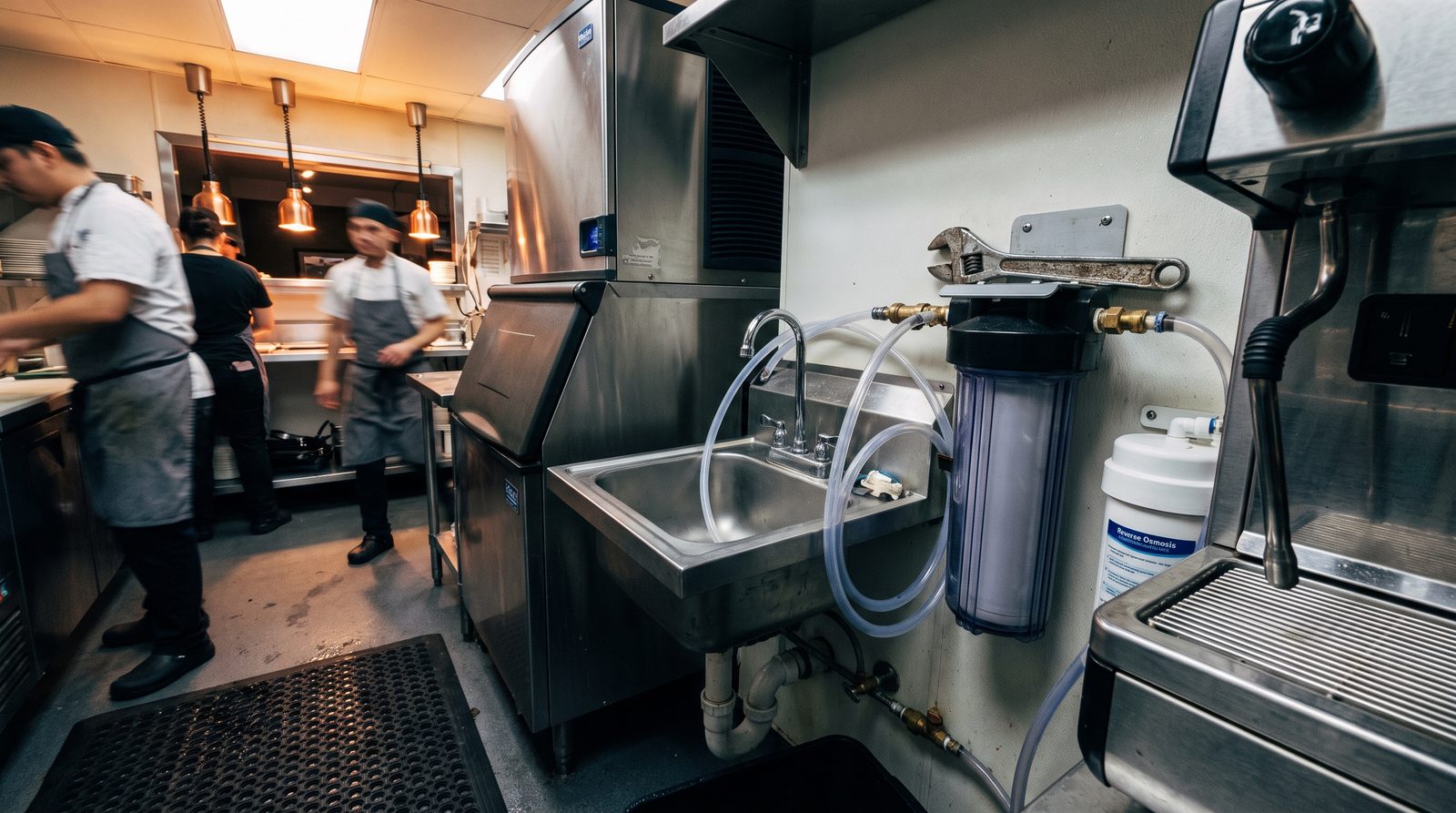
| Ice machine | Cleaner ice, less scale | Sediment filter and carbon filter, plus scale control as the machine maker requires | Sediment filter S10-5, carbon block CB-10-5m |
| Espresso and coffee brewers | Steady taste, no scale | RO with a blending valve or remineralization stage set to the machine maker’s water spec | Commercial RO 100 GPD, 200 GPD |
| Combi ovens and steamers | No scale in the steam generator | Softener plus RO, sized to the equipment | Commercial RO 200 GPD, 400 GPD |
| Fountain drinks | No chlorine taste | Carbon filtration | 10BB GAC cartridge, KDF-GAC 10 inch cartridge |
Every machine maker lists the water its equipment accepts, so read the manual before you choose. Cartridges sit in a cartridge filter housing, and the full range is under filter cartridges.
Size by the busiest hour, not the daily total
AMPAC’s commercial RO guidance is to size on peak demand. A restaurant that uses 300 gallons across a four-hour dinner service is drawing 75 gallons an hour. Run straight from the RO with no tank, that rate is the equivalent of 1,800 gallons a day. With a storage tank that fills between rushes, the RO only has to make about 300 gallons a day, so a 400 GPD system gives margin. The numbers are an example. Count your own peak hour.
On our commercial RO page, the 100 GPD model suits cafes, small clinics, coffee and ice. The 200 GPD model suits restaurants and small offices, the 400 GPD model suits busy kitchens and small labs, and the 800 GPD model suits hotels and multi-station kitchens. See all of them under commercial RO systems.
Want a setup matched to your kitchen?
Send your water source, your equipment list and your busiest hour. We will recommend filtration or RO for each machine and send pricing within 24 hours.
Keep it running
Filters and membranes wear out on a schedule. Follow each manufacturer’s change interval, and keep a log so you can show what was changed and when. Our commercial RO maintenance checklist lists what to check and how often.
What to send for a quote
- Your water source (city, well) and your utility’s latest water quality report
- The make and model of each ice, coffee and steam machine, or the water spec in its manual
- Your busiest hour and total daily water use
- Whether you have space for a storage tank
Frequently Asked Questions
Does ice have to be made with RO water?
No. The Food Code says ice shall be made from drinking water, and city water that meets drinking water standards qualifies. RO is a choice for taste and scale control. Check your machine maker’s water requirements too.
Can I just add a filter to my ice machine?
Often yes. A sediment filter and a carbon filter handle particles and chlorine taste. If your water is hard, you may also need scale control, so follow the machine maker’s guidance and ask us about your water report.
What size RO does a coffee shop need?
On our commercial RO page, the 100 GPD model is listed for cafes, small clinics, coffee and ice, and the 200 GPD model for restaurants and small offices. The right size depends on your busiest hour and whether you use a storage tank.
Who inspects restaurant water systems?
Your local health department, using the Food Code version your state or county adopted. Ask them what they check before you install or change equipment.
Conclusion
Start with your water report and your equipment manuals, then match filtration or RO to each machine and size it on your busiest hour. Request a quote from AMPAC Water Systems and our engineers will specify the setup.
Sources
- US FDA: Food Code 2022
Section 3-202.16 (ice shall be made from drinking water) and section 5-102.11 (public water system water must meet 40 CFR 141 and state standards). - US FDA: FDA Food Code
The Food Code is a model that regulators use to develop or update their own food safety rules. - US EPA: Secondary Drinking Water Standards, Guidance for Nuisance Chemicals
TDS at 500 mg/L as a secondary standard, and the effects listed for it. Secondary standards are non-enforceable guidelines.
AMPAC Water Systems designs and manufactures advanced water treatment solutions for commercial, industrial, and municipal applications. From RO systems and PFAS removal to zero liquid discharge and smart water technology — engineered for your needs.