
Key Takeaways
- Sediment filters remove suspended solids (sand, silt, rust, clay). They don’t treat dissolved chemicals or bacteria.
- Micron rating is the single most important spec: lower numbers catch finer particles but clog faster.
- For most whole-house applications, a 5–20 micron cartridge is the practical starting point.
- Commercial and industrial systems typically run two-stage pre-filtration: a 20-micron bulk filter followed by a 5-micron polishing filter.
- Sediment pre-filtration is required before any RO membrane. Skipping it cuts membrane life by 50–80%.
- Replace cartridges on a schedule, not just when flow drops. By the time you notice pressure loss, the filter is already overloaded.

What Does a Sediment Filter Actually Do?
The name is straightforward, but it’s worth being precise: a sediment filter physically traps suspended particles in water. Sand, silt, rust flakes, pipe scale, clay, organic debris. The filter holds them back so they don’t reach your appliances, fixtures, membranes, or downstream treatment equipment.
What sediment filters don’t do: they won’t reduce chlorine, remove dissolved minerals, kill bacteria, or address any dissolved contaminants. That’s the job of activated carbon, UV systems, RO membranes, or other treatment stages. Sediment filtration is particle removal only.
That distinction matters when you’re designing a water treatment system, because sediment filtration almost always comes first. It protects everything downstream. An RO membrane that sees unfiltered well water with 50 ppm of suspended solids will foul in days. The same membrane, protected by a proper sediment pre-filter, can run for 2–3 years.
Micron Ratings: What the Numbers Mean
Every sediment filter carries a micron rating: the smallest particle size it’s designed to capture. One micron (µm) equals one-millionth of a meter. Human hair runs about 70 microns in diameter, for reference.
Common micron ratings and what they catch:
| Micron Rating | Particle Size | Typical Use |
|---|---|---|
| 100 µm | Coarse sand, large debris | Spin-down pre-strainers, irrigation |
| 50 µm | Fine sand, large silt | First-stage pre-filtration |
| 25 µm | Medium silt, scale | General pre-filtration |
| 10 µm | Fine silt, some sediment | Whole-house first stage |
| 5 µm | Fine clay, silt, rust | Standard RO pre-filter, whole house |
| 1 µm | Ultra-fine particles, cysts (Giardia, Cryptosporidium) | Point-of-use, food service, hospital |
| 0.35–0.5 µm | Bacteria-sized particles | Specialty absolute-rated filters |
One more spec you’ll see: nominal vs. absolute ratings. A nominal 5-micron filter captures most particles at 5 microns, typically 70–90%. An absolute 5-micron filter catches 99.9%+ at that size. For cyst removal (Giardia, Cryptosporidium), you need an absolute-rated filter. For sediment pre-filtration before an RO system, nominal ratings are generally fine.
Lower isn’t always better. A 1-micron filter on a high-sediment well will clog in days. Matching the micron rating to your actual water conditions, measured by a water test rather than guessed at, is how you get a filter that lasts.
Types of Sediment Filters: Spin-Down, Cartridge, and Bag
Three main filter types, each with a different use case.
Spin-Down (Screen) Filters
Spin-down filters use centrifugal force and a mesh screen to separate sediment from water. Water enters the housing tangentially, heavier particles drop into a collection chamber at the bottom, and clean water exits through the screen.
Pros: Reusable, easy to flush, no replacement cartridges, handle high flow rates well.
Cons: Coarse filtration only (typically 100–500 microns). Not suited for fine clay or silt.
Best for: irrigation lines, incoming well water with coarse sand, protecting a pump from debris. They’re almost always the first stage before finer filtration, not a standalone solution.
Cartridge Filters
The most common type for residential and light commercial use. A replaceable cartridge sits inside a standard filter housing (Big Blue, standard 10″ × 2.5″, or 20″ housings). Three cartridge media options:
String-wound: Cotton or polypropylene thread wound around a core at varying densities. The outer layers catch large particles; the inner, more tightly wound core catches finer ones. Good for sediment-heavy water and relatively cheap. The downside is that they can unwind under high pressure surges and release trapped particles back into the line.
Melt-blown (depth-gradient): Polypropylene fibers blown into a matrix with graduated pore sizes, coarser outside and finer inside. Better particle retention than string-wound, and they won’t unwind. This is the most common type in residential water systems and generally what you want for RO pre-filtration.
Pleated: Polyester or polypropylene pleated into accordion folds, like an air filter. Far more surface area than the other types, so they handle higher flow rates and last longer before pressure drop becomes an issue. Washable and reusable in many cases. Better for lower sediment loads where you want to extend service intervals.

Bag Filters
Bag filters hang inside a stainless-steel or polypropylene housing and capture particles in a felt or mesh bag. They handle very high flow rates (50–500+ GPM) and hold large sediment volumes before needing replacement or cleaning.
Primarily an industrial and commercial technology. You’ll see them in food processing, municipal water systems, industrial process water, and large cooling tower systems. Not practical for residential use.
For commercial reverse osmosis systems above about 5,000 GPD, bag pre-filtration is often the right first stage before cartridge or multimedia bed filtration.
Sizing a Sediment Filter: Whole House vs. Commercial
Wrong sizing means either inadequate filtration or constant cartridge changes. Here’s how to approach it.
Whole-House Sizing
For a typical home (2–4 bathrooms, 1–1.5-inch service line), a standard 10″ × 4.5″ Big Blue housing with a 5-micron melt-blown cartridge is the common starting point. Flow capacity runs 10–15 GPM, which covers peak demand without pressure drop you’d actually notice.
Heavy sediment loads, meaning cloudy well water, high iron, or frequent brown staining on fixtures, warrant a two-stage setup: a 20-micron first stage to handle the bulk load, followed by a 5-micron second stage for polishing. This dramatically extends cartridge life on the second stage.
Key sizing inputs:
- Flow rate needed (GPM): size the housing to your peak demand
- Sediment concentration: higher loads need larger cartridge volume or more frequent changes
- Micron target: dictated by what’s downstream (RO = 5 µm, whole-house general = 10–25 µm)
Still weighing whole-house versus under-sink filtration? Our whole house water filter vs. under-sink comparison covers when each approach makes sense.
Commercial Sizing
Commercial systems, hotels, restaurants, light manufacturing, car washes, food service, typically run 20–500 GPM. The filter housing needs to match that flow without creating a pressure drop that starves the system.
Options at commercial scale:
- Multiple Big Blue housings in parallel: cost-effective for 30–100 GPM
- Multi-cartridge commercial housings (10, 20, or 40 cartridges): 50–500 GPM range
- Bag filter systems: high-volume, high-sediment industrial applications
For commercial RO pre-filtration, AMPAC typically specifies a multi-stage approach: 20-micron coarse pre-filter, 5-micron fine pre-filter, then carbon block (if chlorine is present) before the membrane array. This sequence protects the membrane elements and keeps system downtime low. When evaluating suppliers for large systems, our guide on choosing an industrial RO manufacturer covers the factory-testing and spare-parts questions to ask before signing.
When to Replace a Sediment Filter
The honest answer: most people wait too long. By the time you notice reduced flow at your fixtures, the filter housing is already operating under significant differential pressure, which can force particles through the media or cause channeling.
Replacement guidelines:
- Standard 10″ cartridge, municipal water, light sediment: every 3–6 months
- Big Blue 4.5″ cartridge, municipal water: every 6–12 months
- Well water with moderate sediment: monthly to every 3 months, depending entirely on your water
- Pre-RO cartridges: replace when inlet/outlet pressure differential hits 10–15 PSI, or on a fixed schedule, whichever comes first
Install a differential pressure gauge across any critical filter housing. It’s a $30–50 part that tells you exactly when to change the cartridge. No guessing.
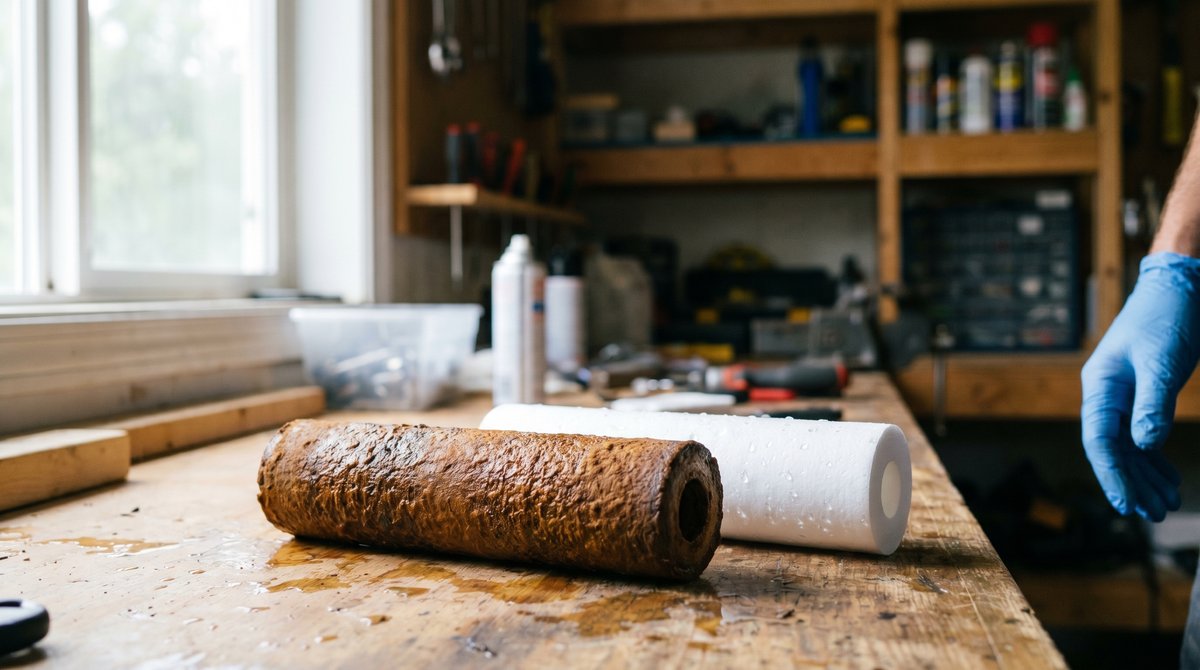
Color isn’t a reliable indicator, either. A cartridge filtering clear water with dissolved iron will stay white while collecting significant ferrous iron. Pull and inspect on a schedule; don’t trust appearances.
Whole-house sediment filter cartridges are available in standard sizes. If you know your housing model, replacement is straightforward.
Sediment Pre-Filtration for RO Membranes
This section gets its own heading because it’s where sizing errors cause the most expensive problems.
An RO membrane is a tight semi-permeable sheet. Typical commercial membranes reject particles down to 0.0001 microns. Sediment doesn’t pass through; it piles up on the membrane surface (fouling) and restricts flow. Once fouled, the membrane requires chemical cleaning, and repeated fouling permanently degrades rejection rates.
Required pre-filtration before any RO system:
- Coarse sediment removal (20–50 µm spin-down or cartridge)
- Fine sediment polish (5 µm melt-blown cartridge, nominal or absolute)
- If chlorine is present: carbon block or chemical dechlorination before the membrane (chlorine degrades polyamide membranes rapidly)
AMPAC’s commercial RO systems, from 100 GPD up to 100,000 GPD, come with integrated pre-filtration designed to the feed water quality. For retrofits or standalone RO installations, contact the AMPAC engineering team to spec pre-filtration correctly for your source water.
Skipping pre-filtration to save $100 on filter housings is the most reliable way to spend $2,000–$15,000 replacing membranes ahead of schedule.
Frequently Asked Questions
What micron rating should I use for well water?
Start with a water test. It tells you suspended solids concentration, iron content, and turbidity. For most private well applications, a two-stage setup works well: 20-micron first stage, 5-micron second stage. If your water is exceptionally turbid (muddy appearance), add a spin-down strainer upstream. On a clean municipal supply, a single 5–10 micron cartridge is usually enough.
Can a sediment filter remove bacteria or chemicals?
No. Sediment filters are purely mechanical. Bacteria are typically 1–10 microns, so an absolute 0.5-micron filter blocks them physically, but it’s not a disinfection method and doesn’t address chemical contamination. For biological treatment, pair sediment filtration with UV disinfection or a properly rated ultrafiltration membrane.
How do I know if my sediment filter is working?
The most reliable method is a differential pressure gauge across the housing: if inlet pressure is 60 PSI and outlet is 58 PSI, the filter is clean. As it loads with sediment, that gap widens. A 10–15 PSI differential is the typical replacement trigger. You can also compare turbidity readings before and after the filter. A turbidity meter costs about $50 and takes 30 seconds to use.
Do I need a sediment filter before a water softener?
Worth having, especially on well water. Sediment, particularly iron particles, can foul ion exchange resin in a softener and reduce its capacity over time. A 20–50 micron pre-filter ahead of the softener extends resin life and reduces backwash frequency. It’s cheap insurance.
Conclusion
Sediment filtration is the unglamorous part of water treatment that makes everything else work. Get it right and everything downstream runs longer, performs better, and costs less to maintain. Undersize it or skip it and you’re on a treadmill of premature replacements and avoidable service calls.
One thing the specs won’t tell you: a $30 differential pressure gauge across your filter housing is worth more than any “smart” replacement reminder schedule. It’s the only indicator that actually reflects what’s happening inside the cartridge.
AMPAC Water Systems has built commercial and industrial water purification equipment in Utah since 1993. From single sediment filter housings to complete multi-stage pre-treatment systems for large RO installations, the engineering team can size and specify the right equipment for your source water and flow requirements. For systems that include a whole-house RO stage, see our guide on whole house alkaline water filtration — remineralization after RO restores pH and taste.
Related Products & Services
- Sediment Filters
- Sediment Filter Cartridges
- Membrane Elements
- Commercial Reverse Osmosis Systems
- Contact Us
PHP: 2026-06-12 17:53:55 [notice X 0][/home/ampacws/htdocs/ampacwatersystems.com/public/wp-content/plugins/elementor-pro/core/database/model-base.php::66] ElementorProCoreDatabaseModel_Base::query(): Implicitly marking parameter $connection as nullable is deprecated, the explicit nullable type must be used instead [array (
‘trace’ => ‘
#0: ElementorCoreLoggerManager -> shutdown()
‘,
)]