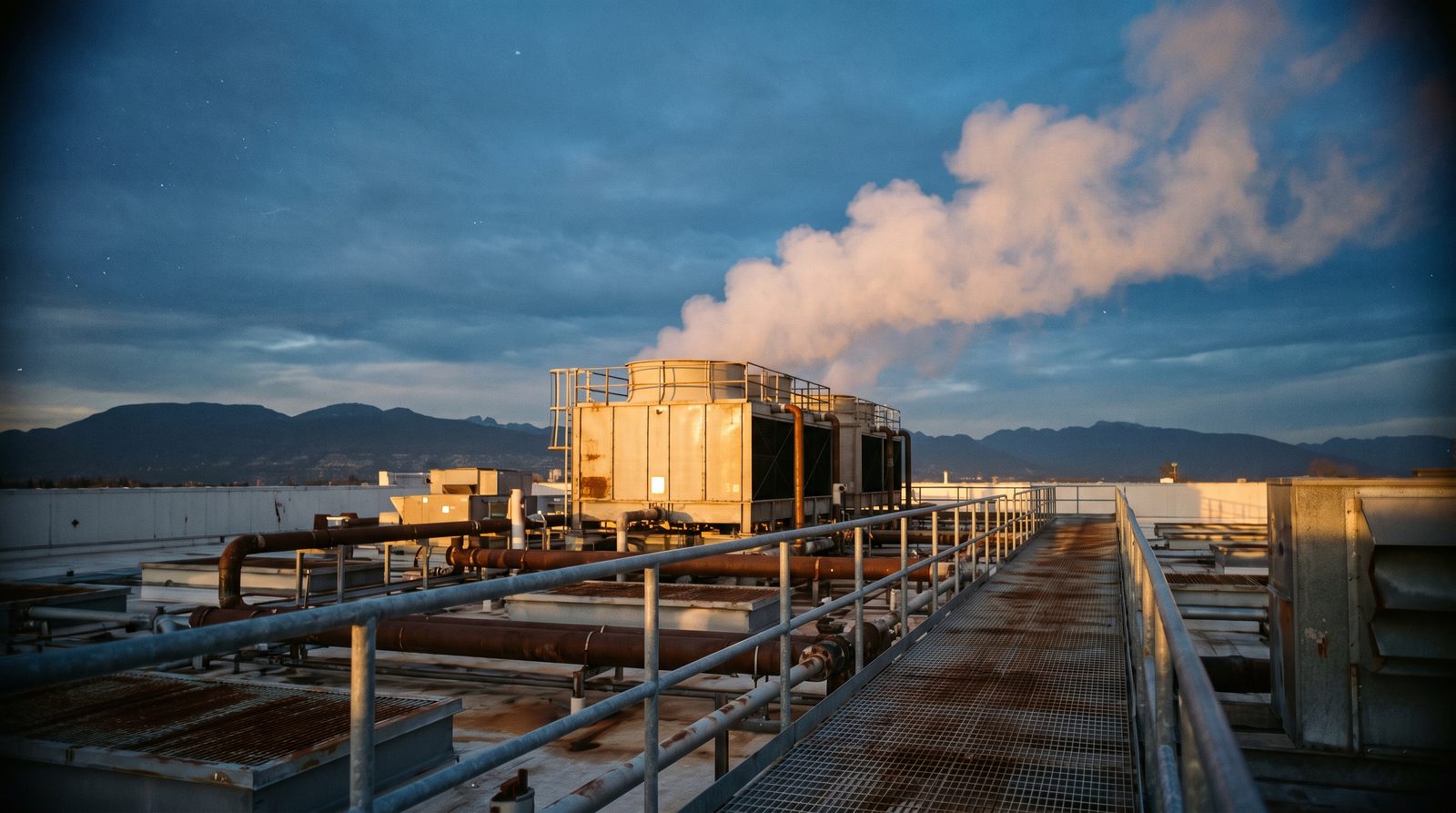

A cooling tower loses water three ways: evaporation, blowdown and drift. The US Department of Energy writes it as make-up water equals evaporation plus blowdown plus drift, and it says controlling blowdown is the biggest chance to save water in a tower (US Department of Energy, 2026). Reverse osmosis (RO) helps in two places. It can clean the make-up water before it enters the tower, so the tower can run more cycles. It can also treat part of the blowdown and send clean water back. You can size either option from numbers you already have.
What cycles of concentration mean
Dissolved solids enter a tower in the make-up water and leave in the blowdown. The ratio of dissolved solids in the blowdown to dissolved solids in the make-up is the cycles of concentration. Because the solids go in with the make-up and out with the blowdown, the cycles also come out close to the ratio of make-up volume to blowdown volume (US Department of Energy, 2026).
More cycles means less water used, but only up to a point. Dissolved solids rise with every added cycle, which can cause scale and corrosion unless they are controlled. The DOE says many systems run at two to four cycles, six or more may be possible, and going from three cycles to six cuts make-up water by 20% and blowdown by 50%. How far your tower can go depends on the make-up water quality and the treatment program.
| Cycles of concentration | Make-up water as a multiple of evaporation |
|---|---|
| 2 | 2.0 x |
| 3 | 1.5 x |
| 4 | 1.33 x |
| 6 | 1.2 x |
The table comes from the DOE equation with drift ignored: make-up = evaporation x cycles / (cycles - 1). Going from three cycles to six drops make-up from 1.5 to 1.2 times evaporation, which is the 20% saving the DOE quotes.
Where RO fits: make-up or blowdown
RO on the make-up water. The DOE says the cycles a tower can reach are limited by the make-up water and the tower chemistry. If RO takes dissolved solids out of the make-up, the tower can run more cycles before the blowdown reaches its limit. This is the simpler design because the feed water is cleaner.
RO on the blowdown. This treats the water you were about to send to drain and returns the permeate to the tower. The feed is the concentrated stream, so it carries the scale-forming salts, such as calcium and silica, that the tower was already struggling with. Pretreatment and a conservative recovery are part of the design, and the recovery comes from a water analysis, not a catalog number. AMPAC lists a typical recovery of 33% to 50% on the AP4400-LX product page. A blowdown stream may need less.
Neither option replaces your treatment program. The DOE notes that typical programs include corrosion and scaling inhibitors and biological fouling inhibitors, and it advises working with a water treatment specialist to find the maximum safe cycles and the matching conductivity. Install a conductivity controller so blowdown follows the water chemistry, not a timer.
How to size it in five steps
- Measure the blowdown. Record flow in gallons per minute and how many hours a day the tower runs.
- Measure conductivity. Check the conductivity of the make-up and the blowdown. Their ratio is your current cycles.
- Get a water analysis. Hardness, silica, alkalinity and total dissolved solids decide the pretreatment and the recovery.
- Set the recovery. Agree it with your supplier based on the analysis.
- Convert to gallons per day. Permeate per day = feed per day x recovery. Pick the model that covers it with some margin.
Worked example (assumed numbers, replace them with yours). A tower blows down 10 gallons per minute around the clock, which is 14,400 gallons a day. At an assumed 50% recovery, the RO makes 7,200 gallons of permeate a day. That sits between the 6,000 GPD commercial turnkey system and the 10,000 GPD industrial system. The 6,000 GPD unit would treat most of the stream. The 10,000 GPD unit treats all of it with room for growth.
Want your tower sized?
Send the blowdown flow, hours of operation, make-up and blowdown conductivity, and a water analysis. Our engineers will size an RO system for the make-up or the blowdown and reply within 24 hours.
What the savings can look like
Annual savings are the permeate you reuse times your combined water and sewer rate, minus what the RO costs to run (power, membranes, chemicals and labor). In the example above, 7,200 gallons a day over 365 days is 2,628,000 gallons a year. At an example rate of $5 per 1,000 gallons, that is about $13,140 a year before operating costs. Use your own bill for the rate. The numbers are an illustration, not a quote.
The sewer side matters because blowdown is a discharge. The US EPA publishes national effluent guidelines for industrial categories, and your local sewer district sets its own acceptance limits, so confirm both before you change what goes to drain (US EPA, 2026). Plants that cannot send RO concentrate to sewer should look at zero liquid discharge systems and our industrial water reuse guide.
Utah notes
Utah make-up water is often hard, which raises the scaling risk in the tower and in an RO system. Check your utility’s figures on our Utah water hardness by city page before you choose pretreatment. Data center operators who read our piece on AI data center water use will recognize the same water balance at a larger scale.
What to send for a quote
- Tower size or tonnage, and hours of operation
- Blowdown flow in gallons per minute
- Make-up and blowdown conductivity
- A water analysis (hardness, silica, alkalinity, TDS)
- Where the RO reject will go (sewer, reuse or evaporation)
Browse the full range of industrial RO systems and commercial RO systems, or run the water treatment calculators for a first estimate.
Frequently Asked Questions
What are cycles of concentration in a cooling tower?
They are the ratio of dissolved solids in the blowdown to dissolved solids in the make-up water. The DOE adds that the cycles are also close to the ratio of make-up volume to blowdown volume (US Department of Energy, 2026).
How many cycles can a cooling tower run?
Many systems run at two to four cycles, and six or more may be possible, according to the DOE. Your limit depends on the make-up water quality and your treatment program, so ask your water treatment specialist.
Should RO treat the make-up water or the blowdown?
Make-up RO is simpler because the feed water is cleaner, and it lets the tower run more cycles. Blowdown RO recovers water that would go to drain, but the stream is concentrated and needs pretreatment and a conservative recovery. The right choice comes from a water analysis and your discharge limits.
Does RO replace chemical treatment in a cooling tower?
No. The DOE lists corrosion and scaling inhibitors and biological fouling inhibitors as part of typical treatment programs. RO changes the water going into the program. Your treatment specialist should confirm any change.
How do I size an RO system for blowdown?
Multiply the daily blowdown volume by the recovery you can use to get permeate gallons per day, then pick a model with margin. The five steps above walk through it.
Conclusion
Run the water balance first: make-up, evaporation, blowdown and the cycles you run today. Then decide whether RO belongs on the make-up, on the blowdown or on both. Request a quote from AMPAC Water Systems with your numbers and our engineers will size the system.
Sources
- US Department of Energy FEMP: Cooling Tower Management (Best Management Practice #10)
The make-up, evaporation, blowdown and drift balance, cycles of concentration, typical two to four cycles, the three-to-six-cycle savings, conductivity control and treatment programs. - US EPA: Effluent Guidelines
National standards for wastewater that industrial categories discharge to surface waters and municipal sewage treatment plants.
AMPAC Water Systems designs and manufactures advanced water treatment solutions for commercial, industrial, and municipal applications. From RO systems and PFAS removal to zero liquid discharge and smart water technology — engineered for your needs.