
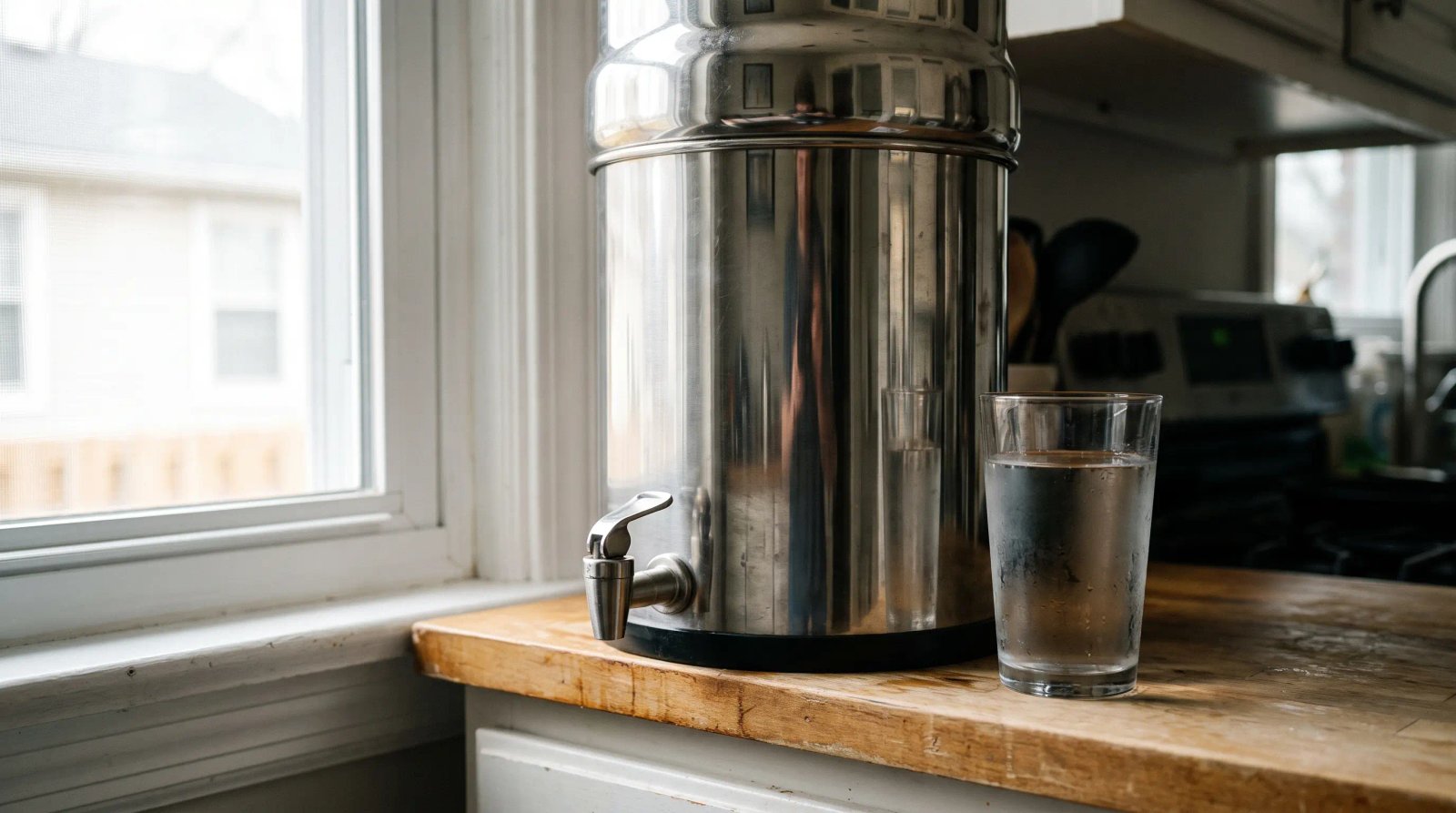

A gravity water filter produces clean drinking water without electricity, water pressure, or plumbing connections. You pour source water into the top chamber. Gravity does the rest. The water passes through the filter media and collects in a lower reservoir as filtered water, ready to use. This gravity-fed design needs no pump, no power, and no installation.
For off-grid households, emergency preparedness, and locations where infrastructure is unreliable, that simplicity is the point. Unlike powered water filter systems that need electricity or line pressure, a gravity unit works anywhere. This guide covers how gravity filtration works, what filter types are used, what these systems remove and what they do not, and how to choose the right one.
How gravity water filtration works
Water in the upper chamber passes through a filter element under gravity alone. Ceramic, hollow fiber, activated carbon block, or some combination of these. The process is deliberately slow - lower flow rates mean longer contact time between water and filter media, which improves contaminant reduction for a range of pollutants.
Most gravity systems use a stacked design: upper reservoir, filter element in the middle, lower reservoir for treated water with a spigot at the base. Housings are typically BPA-free plastic or stainless steel, depending on the system and where it’s used. Capacity ranges from about 1.5 gallons for countertop units to 6 to 10 gallons for larger household or camp-style systems.
Types of gravity water filter media
Most gravity water filter systems rely on one or a combination of three filter media types.
Ceramic filter elements
Ceramic elements are fired from diatomaceous earth to produce a rigid, porous matrix with a consistent pore size - usually 0.2 to 0.3 microns. At that scale, bacteria and protozoa cannot pass through. The filter reliably removes Giardia, Cryptosporidium, and E. coli.
Ceramic elements are washable. When flow drops because the surface has clogged with captured particles, scrubbing the exterior with a clean brush restores flow without replacing the element. A properly maintained ceramic element lasts 12 to 24 months before needing replacement. That is a meaningful cost advantage over disposable media.
Hollow fiber membrane filters
Hollow fiber elements use thousands of tiny tubes with walls perforated at the 0.1-micron level. Water passes through the tube walls; bacteria and protozoa are blocked at the exterior surface. Very effective at biological removal. Very lightweight.
Unlike ceramic, hollow fiber cannot be scrubbed - it is backwashed by reversing flow to dislodge debris. Service life is typically 1,000 to 2,000 gallons depending on source water quality.
Activated carbon blocks
Carbon addresses what ceramic and hollow fiber cannot: dissolved chemicals, chlorine, chloramines, volatile organic compounds, and odor. Many gravity systems combine a ceramic or hollow fiber primary element with an activated carbon secondary stage to address both biological and chemical removal in a single pass.
Carbon blocks are consumed as they adsorb contaminants. They cannot be cleaned or regenerated. Budget for replacement based on volume processed and the chemical load of your source water.
What gravity water filters remove - and what they do not
Gravity systems with ceramic or hollow fiber elements reliably remove bacteria, protozoa (Giardia, Cryptosporidium), sediment, and particulate matter. Some systems with specific ion-exchange media also reduce certain heavy metals.
What most gravity systems do not remove:
Viruses. Most ceramic and hollow fiber gravity filters do not remove viruses, which measure around 0.025 microns - below the range where mechanical filtration works. If your source water carries viral risk, you need UV treatment or chemical disinfection in addition to filtration.
Dissolved inorganic contaminants. Fluoride, nitrates, arsenic, lead. These are dissolved ions, not particles. Ceramic and hollow fiber membranes do not stop them. Some gravity water filter systems add a separate fluoride filter cartridge, usually activated alumina, to close that gap - but the standard ceramic and carbon stages will not. Only reverse osmosis membranes remove dissolved inorganics reliably across the board.
Total dissolved solids. Gravity filtration does not reduce TDS. High TDS from agricultural runoff, hardness minerals, or industrial contamination requires an RO system, not a gravity filter.
When a gravity water filtration system is the right choice
Off-grid living. No power, no problem. A gravity filter with ceramic and carbon stages runs indefinitely from any water source - well, spring, collected rainwater. It does not care whether the grid is on.
Emergency preparedness. A gravity filter is the production alternative to stored bottled water. It treats water continuously from whatever source is available. Most ceramic-element systems can handle surface water from streams or ponds, which matters when municipal infrastructure goes down for an extended period.
Rentals and temporary installations. When you cannot modify plumbing and need better water quality than tap, a countertop gravity filter installs without tools and moves with you.
Reducing bottled water costs. A countertop gravity unit treating municipal tap water for chlorine and odor costs a fraction of what bottled water costs over a year. The math is not close.
Choosing the best gravity water filtration system
Match capacity to your daily need
Gravity systems are slow. A typical ceramic element passes 0.5 to 1.5 gallons per hour. A household of four using 1 gallon of drinking water per person per day needs 4 gallons - 3 to 8 hours of filter run time. A system with multiple filter elements running in parallel speeds this up considerably. Know your daily need before you size the system.
Start with biological safety
If your source water is a well, surface source, or any water with biological uncertainty, choose a gravity filter with a certified 0.2-micron or smaller ceramic or hollow fiber element. Carbon-only gravity filters remove chemicals and improve taste. They do not block bacteria. Do not use them for source water with pathogen risk.
Know your contaminant profile
Municipal tap water with chlorine issues? Carbon-stage gravity filter is sufficient. Heavy metals or dissolved solids? A gravity filter alone will not address that - look at an RO system instead. Biological risk from a surface source? Ceramic or hollow fiber element, full stop.
Check for independent testing
Manufacturer claims alone are not proof of performance. When comparing options, look for filter elements tested to NSF/ANSI 42 or 53 standards, and ask for test results showing actual contaminant reduction rates rather than marketing copy.
Gravity filters vs. reverse osmosis: understanding the difference
These two technologies solve different problems and they are not interchangeable. Gravity filters handle biological contamination from any source without power or pressure. RO systems remove dissolved inorganic contaminants - fluoride, arsenic, nitrates, lead, TDS - but they require 30 to 80 PSI of water pressure and produce some waste water in the process.
On treated municipal water with a primary concern about dissolved contaminants, an under-sink RO system delivers more complete treatment. For off-grid use, emergency situations, or biological risk scenarios, a gravity system with a quality ceramic element is the practical starting point.
AMPAC stocks filtration components and complete systems for both. Contact AMPAC to discuss which approach fits your water quality concerns and installation situation.
Frequently Asked Questions
Does a gravity water filter remove viruses?
No. Most ceramic and hollow fiber elements don’t remove viruses, which measure around 0.025 microns - below the range mechanical filtration reaches. UV treatment or chemical disinfection is needed for viral risk.
Can a gravity filter remove fluoride, lead, or arsenic?
No. Those are dissolved inorganic contaminants, not particles, so ceramic and hollow fiber membranes don’t stop them. A separate fluoride filter cartridge can address fluoride specifically. Only reverse osmosis removes the full range of dissolved inorganics reliably.
How long do ceramic filter elements last?
12 to 24 months with proper maintenance. Ceramic elements are washable - scrubbing the exterior restores flow - unlike hollow fiber elements, which are backwashed and typically last 1,000 to 2,000 gallons.
How fast does a gravity filter produce water?
A typical ceramic element passes 0.5 to 1.5 gallons per hour. Systems with multiple elements running in parallel speed this up.
Gravity filter or reverse osmosis - which do I need?
Gravity filters handle biological contamination from any source without power or pressure. RO systems remove dissolved inorganics like fluoride, arsenic, and TDS but need 30-80 PSI of water pressure.
Sources and further reading
- NSF/ANSI 58: Reverse Osmosis Drinking Water Treatment Systems
NSF - the certification standard for residential and light commercial RO systems. - Basic Information about Your Drinking Water
US EPA - how public water systems are regulated and what a consumer confidence report covers. - Water - emergency preparedness
Ready.gov - federal guidance on emergency water supply and treatment.