
AMPAC Water Systems designs and manufactures seawater desalination watermakers for commercial and industrial buyers who need reliable fresh water where the grid ends. Since 1993, we have shipped systems to more than 120 countries - from single-vessel marine units producing 200 gallons per day to multi-skid desalination plants delivering over 100,000 gallons per day for island municipalities, military bases, and offshore oil platforms.
This page covers how seawater watermakers work, what applications they serve, how to size one for your needs, and what separates AMPAC systems from catalog alternatives.
What is a seawater desalination watermaker?
A seawater watermaker is a reverse osmosis (RO) system built to convert raw seawater - typically 30,000 to 45,000 ppm total dissolved solids (TDS) - into potable or process-grade fresh water. High-pressure pumps, usually operating between 800 and 1,000 psi, force feed water through spiral-wound semi-permeable membranes. Salt, minerals, bacteria, and most contaminants are rejected and discharged as concentrated brine. The permeate (product water) meets drinking water standards or can be post-treated to any required specification.
Unlike municipal RO systems built for brackish water at 2,000-10,000 ppm TDS, seawater RO systems require higher operating pressures, corrosion-resistant materials - duplex stainless steel, fiberglass, HDPE - and energy recovery options to run economically. AMPAC engineers every system to the actual feed water salinity, temperature, and recovery rate at the installation site, not to a generic average.
Applications
Marine vessels and yachts
Marine watermakers must be compact, vibration-tolerant, and serviceable by the crew without specialized tooling. AMPAC marine units are built on stainless steel or powder-coated frames with 316 SS high-pressure components, sized to fit engine rooms on yachts, fishing vessels, ferries, and commercial ships. Output ranges from 100 GPD for a day-sailor supplement to 6,000 GPD for a commercial vessel primary supply.
- Feed: open ocean seawater, 30,000-42,000 ppm TDS
- Product TDS: typically < 500 ppm (WHO drinking standard < 600 ppm)
- Power options: 12V DC, 24V DC, or 120/240V AC
- Certifications: Class 1 Division 2 (C1D2) units available for hazardous-area deck installations
Offshore oil and gas platforms
Offshore platforms need watermakers rated for hazardous locations and continuous-duty cycles. AMPAC C1D2-rated systems meet NEC standards for Class 1, Division 2 environments. We have supplied platform watermakers for Gulf of Mexico, North Sea, and Middle East operations, with systems sized from 2,000 to 50,000+ GPD depending on crew size and operational requirements.
Military and government field operations
Field-deployable watermakers must start fast, run on variable power sources, tolerate difficult feed water, and be maintained by non-specialist personnel. AMPAC builds:
- Portable skid-mounted units (100-1,500 GPD) on military-spec frames for rapid deployment
- ROWPU-style trailer systems (1,500-10,000 GPD) for base camp water supply
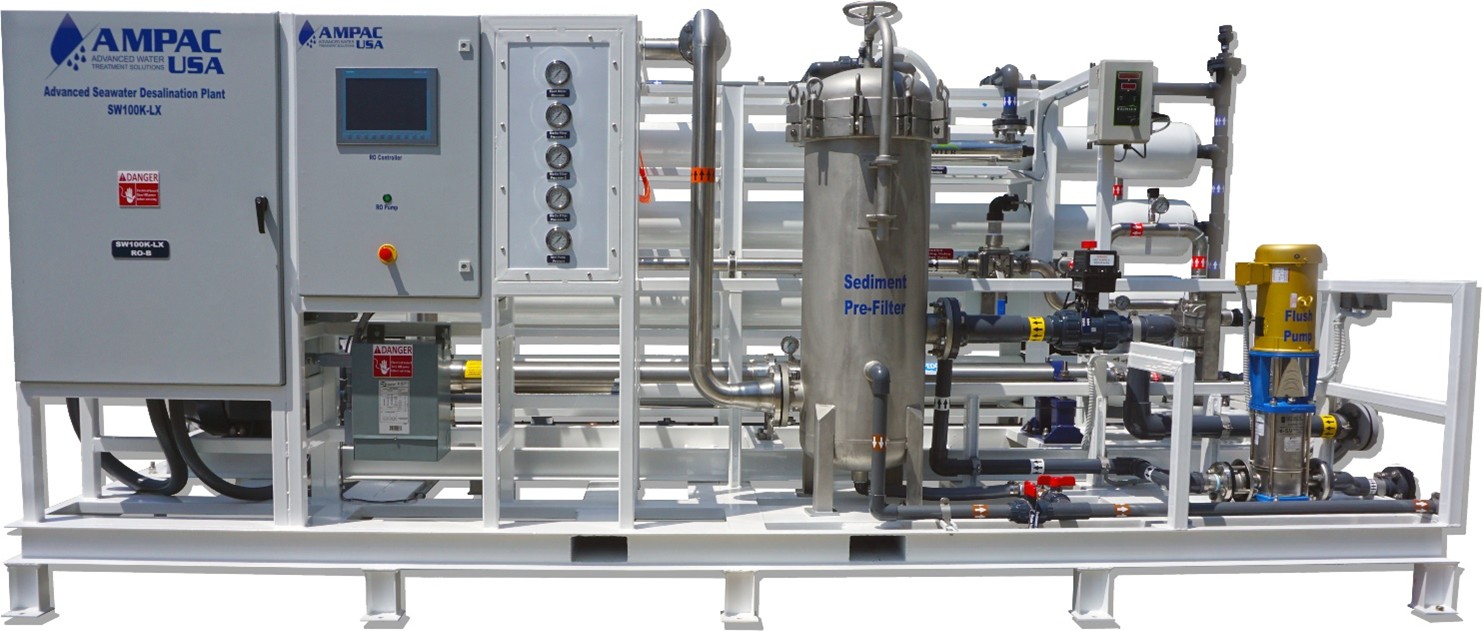
- Containerized desalination plants (10,000-100,000+ GPD) for forward operating bases and large-scale disaster relief
Systems have been supplied to U.S. and international military branches, NGOs, and FEMA-coordinating organizations for hurricane, earthquake, and flood response operations.
Island resorts, hotels, and municipalities
Islands without freshwater aquifers depend entirely on desalination. AMPAC has commissioned island watermaker plants in the Caribbean, Pacific, Indian Ocean, and Mediterranean. For hospitality clients, systems are engineered for quiet operation, aesthetic enclosures, and unattended automated runs, with remote monitoring options available. Output range: 5,000 to 100,000+ GPD.
Emergency and disaster relief
Portable AMPAC watermakers have been deployed to disaster zones in more than 40 countries. Units can be airlifted, truck-mounted, or container-shipped and made operational within hours of arrival at the site.
Capacity sizing guide
| Application | Typical daily demand | Recommended AMPAC system |
|---|---|---|
| Sailboat / small yacht | 50-200 GPD | 100-200 GPD marine compact |
| Motor yacht / charter vessel | 200-1,500 GPD | 500-1,500 GPD marine standard |
| Commercial vessel | 1,500-6,000 GPD | Commercial marine series |
| Military field unit | 500-10,000 GPD | ROWPU / portable skid |
| Island hotel / resort | 5,000-30,000 GPD | Land-based skid-mounted plant |
| Military base / forward FOB | 10,000-100,000 GPD | Containerized plant |
| Island municipality | 50,000-200,000+ GPD | Multi-train modular plant |
General rule: plan for 1 GPD per person per day for basic potable use; 3-5 GPD per person for full domestic demand including cooking, sanitation, and showers.
Why buyers choose AMPAC over catalog alternatives
Most RO equipment is engineered for clean, low-TDS feed water in controlled building environments. Seawater is a different problem: high salinity, biofouling, marine growth, and variable temperature demand purpose-built systems with the right materials, pre-treatment, and pressure ratings.
- Custom-built to your feed water. We run water quality analysis and engineer membrane count, pressure rating, and pre-treatment to your actual seawater conditions - not a catalog average.
- USA-manufactured since 1993. Every system built at our facility, not assembled from third-party kits. Engineering team available throughout the project lifecycle.
- Seawater-grade materials. Duplex stainless steel or fiberglass high-pressure vessels, 316 SS pump heads, UV-resistant enclosures, marine-grade wiring throughout.
- Proven in hostile environments. 500+ installations across marine, military, and off-grid deployments in 120+ countries.
- Post-sale support. Membranes, pre-filters, antiscalants, and spare parts available after installation - not just at the point of sale.
Competitors such as Parker, Pure Aqua, and Applied Membranes offer catalog-configured systems. For straightforward installations with clean feed water and predictable demand, those work. AMPAC wins on complex feed water, hazardous-location ratings, military specifications, remote commissioning, and builds that need engineering sign-off.
Technical overview
Pre-treatment options
- Multimedia (sand/anthracite) filtration for turbid or biologically active seawater
- Cartridge (5µm, 1µm) polishing
- Antiscalant dosing for mineral precipitation control
- Sodium bisulfite (SBS) for dechlorination where pre-chlorination is present
Membrane selection
- Spiral-wound polyamide thin-film composite (TFC) - industry standard for seawater RO
- Brands used: Toray, DuPont FilmTec, Koch/Nitto - selected by feed TDS and application
- Expected membrane life: 3-7 years depending on feed water quality and cleaning frequency
Energy recovery
- Pressure exchangers available for systems 20,000 GPD and above - reduce energy consumption 40-60%
- Energy recovery device (ERD) integration standard on containerized plants
Controls
- PLC with HMI touchscreen for automated operation
- Remote SCADA / telemetry for unattended island or military installations (optional)
- Auto flush, auto shut-down, low-pressure protection standard
Frequently asked questions
What is the difference between a watermaker and a desalination system?
Watermaker is the marine and boating industry term for a compact reverse osmosis unit that converts seawater to fresh water aboard a vessel. Desalination system or desalination plant refers to the same core RO technology deployed at larger scale on land or offshore. AMPAC builds both - the physics and membranes are identical; the difference is size, enclosure, and application-specific engineering.
How much does a seawater watermaker cost?
Marine compact units (100-500 GPD) typically start around $3,000 - $8,000 USD. Commercial marine and offshore units (1,500-10,000 GPD) range from $15,000 - $80,000. Land-based and containerized plants (10,000-100,000+ GPD) are project-priced based on capacity, pre-treatment, enclosure, and installation requirements. Contact us for a quote - we need your daily demand, feed water TDS if known, and power source.
What salinity can an AMPAC watermaker handle?
Standard seawater configuration handles 30,000-45,000 ppm TDS. High-salinity variants are available for Red Sea or Persian Gulf conditions up to 47,000 ppm TDS. For brackish water (1,000-10,000 ppm TDS), a lower-pressure brackish RO system is more energy-efficient - see our brackish water RO systems.
How long do seawater RO membranes last?
3-7 years with proper pre-treatment and routine cleaning. The key factors are feed water quality, pre-treatment effectiveness, operating pressure, and cleaning frequency. AMPAC recommends an annual CIP (clean-in-place) with citric acid for mineral scale and a biocide flush for biological fouling. We supply membrane cleaning chemicals and direct-replacement membranes.
Can a seawater watermaker run on solar power?
Yes. Solar-powered watermakers are practical for island sites, remote coastal camps, and off-grid resorts. The system needs a battery bank or buffer to manage variable solar input. AMPAC has engineered solar-fed desalination installations for islands in the Pacific and Caribbean. Sizing depends on daily production target, site solar irradiance, and available panel area.
Does AMPAC handle international shipping and commissioning?
Yes. Systems ship worldwide, crated and documented for customs clearance. For large installations, AMPAC provides remote commissioning support via video call with detailed startup manuals. On-site commissioning by AMPAC engineers is available for complex projects - contact us to discuss.
What routine maintenance does a seawater watermaker need?
- Daily / per run: check operating pressure, product TDS, flow rates; flush system if idle more than 3 days
- Monthly: inspect and replace 5µm cartridge filters; check antiscalant dosage rate
- Annually: clean membranes (CIP); inspect O-rings and seals; calibrate TDS probe
- Every 3-7 years: replace membranes depending on feed water quality and total runtime
How much fresh water does a 1,000 GPD seawater watermaker actually produce?
At a typical 30-35% recovery rate for seawater RO, a rated 1,000 GPD system feeds approximately 2,900-3,300 gallons per day through the membranes and produces 1,000 gallons of fresh water. The remaining brine is discharged back to sea. Higher-recovery systems are available for applications where brine disposal is restricted, though they require more aggressive pre-treatment.
Request a quote
Every AMPAC watermaker is built to your installation. To get an accurate quote, have the following ready:
- Daily production required (GPD)
- Feed water source (ocean, bay, brackish well) and approximate TDS if known
- Location and environment (vessel, offshore platform, island, desert, military base)
- Power available (12V/24V DC, single- or three-phase AC, generator, solar)
- Any certifications required (C1D2, military spec, NSF)
Browse the full seawater desalination watermaker product line →
Sources and further reading
- Saline Water and Salinity
USGS - the salinity classifications that separate fresh, brackish and seawater feed. - Drinking-water quality guidelines
World Health Organization - international guideline values, used where no US federal limit applies.
Related Resources